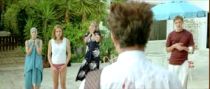
These three siblings live together in an isolated country house with their parents, and the only outside contact the two daughters (Aggeliki Papoulia and Mary Tsoni) and son (Hristios Pasalis) get is when Christina (Anna Kalaitzidou) comes to visit. Even Christina doesn't know where they are, however, as the father (Christos Stergioglou) insists on blindfolding her during her journey to the house, where she takes care of the actually grown up son's sexual needs. The father thinks he has provided everything his family could want, and deliberately confuses his offspring to ensure they don't wish to leave, but how long can this go on?
Dogtooth was an inscrutable effort from writer (with Efthimis Filippou) and director Yorgos Lanthimos which left more than one viewer scratching their heads wondering what they'd just seen, or more aptly what the meaning of it was. Although if you were willing to persevere, you could make a kind of sense of its apparently straightforward story, which was straightforward inasmuch as it had a beginning, a middle and an end and followed a natural progression: it was just what it depicted that was unnatural. We can tell from the start that something is not quite right here when we hear a cassette recording telling us the wrong definitions of various words.
And it gets more strange when it turns out that the three "children", who actually look to be in their twenties and thirties, accept the misinformation they receive from their parents without question. If they really are their parents, as for all we know they could be scientists conducting some obscure experiment; for that matter, we don't even know if the brother and sisters are even related by blood. What we do know we draw from our own experiences and filter the film through them, so if you were somehow unaware of how Planet Earth operated socially, you would be none the wiser from watching this as the charade is sustained throughout, with only the casual hint about what is being achieved by the father.
The point seems to be that if you keep someone in a state of misdirection, if their existence is built around lies, no matter if you think you're shielding them from something, then they will suffer for your untruths. Without even knowing it, as the behaviour of the children is obviously that of disturbed people, as they fight amongst themselves as if they were literally kids, leading to the brother getting his arm cut open in a motivelessly vicious, if brief, attack. All the while the fact that the father is keeping so much from these deliberately retarded adults damages them when the odd example of the "real" world interrupts their lives and causes them to react in bizarre ways, such as a cat in the garden or the machinations of Christina.
The cat ends up stabbed to death with shears by the brother, but Christina's influence may be more detrimental still when, frustrated that the brother refuses to perform cunnilingus on her, she persuades the elder sister to do it in return for arbitrary trinkets. This leads the sister to start licking her other sister, which in turn leads the elder to get her hands on some videotapes as a bribe, which leads the father to find out, which leads to violence with Christina the victim. It should be said that this sterile approach, almost stilted, to character has the potential to disturb or unsettle the audience, with even the close to hardcore sex scenes presented with a clinical stare of the camera lens. We realise that this state of affairs cannot continue, and our fears (or hopes?) come to fruition in the final act. And yet, there's the feeling that this might be too cold for its own good, and Lanthimos is toying with his characters more than examining them.