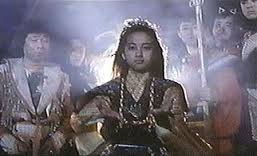
Long ago when the world was an animated cartoon, the Buddha staged a round the world race to choose twelve sacred animals of the Chinese zodiac. Numerous Looney Tunes style antics ensue as the animals trick, trap and taunt each other. Realising the animal gods need someone to keep them in line, Buddha sends to Earth the Lotus Goddess Bai Mai (Liu Chih-Yu). At the same time as the child of light is born amidst a golden Buddhist temple, King Evil - a fifty foot green ogre - manifests on Devil’s Island to lead the army of darkness. Years later, Bai has grown into a lovely young woman protected by her mute companion, boy warrior Kan Chu. When hordes of flying pig-faced demon samurai slaughter the kindly Buddhist monks, Bai Mai and Kan Chu escape to an ancient temple. They are rescued by Dragon (Lin Hsiao Lan), a silver-clad, lightsaber wielding ultimate warrior who blasts bad guys into oblivion. The trio embark on an eventful journey to reunite the remaining animal gods and save the world.
Think Seven Samurai (1954) meets The Banana Splits with religious overtones. Epic sets and mind-blowing weird special effects bathed in out-of-this-world lighting mark Twelve Animals among the most lavish productions by Kinko Films, the madcap Taiwanese outfit behind the craziest (and goriest!) kids movies made in Asia. There is a celebratory tone to the film, recounting a beloved Chinese fable and uniting the studio’s two brightest stars. Busy actress Lin Hsiao Lan - perennial Peter Pan style girl-playing-boy star of Kinko’s Kung Fu Wonderchild (1986) and Child of Peach (1987) - disappears for a long stretch, presumably to film one of her many other movies (she had a parallel career in the Philippines under the alias Cynthia Luster), leaving Liu Chih-Yu to shoulder much of the drama.
Liu Chih-Yu (sometimes billed as Shadow Liu Chih-Yu) started at Kinko playing cute fairies and little princesses before graduating to superstardom as the child heroine of Hello Dracula (1985) and its sequels. It is somewhat unsettling to see her eulogised in slow-motion during a nude bathing sequence, given she can’t have been more than fourteen at the time. Nevertheless, she believably embodies the ideal Buddhist saint spreading love and harmony through stop-motion trickery, trippy optical effects and kick-ass moves. Notably the moment she grows a spinning umbrella from her head that zaps flesh-eating zombies with orange laser beams. If there are two things you can count on from a Kinko kids’ movie, it’s the presence of cartoon pyrotechnics and the scariest zombies this side of Zombie Flesh Eaters (1979). Wisecracking chicken-robot puppets, exploding mice and ingenious death-dealing gadgets also figure into the mix, which makes for the perfect movie to teach rambunctious kids the virtues of tolerance and cooperation.
Things get off to a rip-roaring start and conclude with a truly delirious finale, but sag slightly in the middle. Strange how all Chinese children’s films, from Kinko’s Magic of Spell (1988) and Dragonball: The Magic Begins (1991) to the lavish Hong Kong-Japanese co-production Saga of the Phoenix (1989), share this same fighty-funny-trippy three-act structure. The mid-section gets bogged down in broad humour wherein captive animal gods Monkey, Chicken and Goat (Lam Gwong-Wing) are tortured by having fiery hot chillies shoved up their asses, while Pig (Boon Sam) gets a huge firecracker crammed up his bottom that sends him shooting across the town square.
One can read the twelve squabbling animal gods as allegorical stand-ins for disparate Chinese provinces. Whereas in Hero (2003), these feuding kingdoms are united under an authoritarian emperor, here benevolent Buddhist philosophy finally brings them together. Each animal has their moment of enlightenment signifying their readiness to make a supreme sacrifice. Indeed our heroes really work hard to earn a happy ending. Exploding heads, tragic deaths, breathtaking wire fu and a chorus line of demonic dancing girls all figure into the finale. Both Dragon and the evil Snake Queen (Siu Huen) transform into impressive cel animated flying serpents for an interdimensional duel before a pleasing twist reveals the identity of the elusive twelfth animal, underlining a message of forgiveness and brotherhood. Most jaw-dropping of all, Bai Mai must walk across a bridge of corpses (!) towards the transcendent 2001: A Space Odyssey (1968) style finale. Liu Chih-Yu performs the closing, sing-along children’s song: “There are so many strange things hidden in this world.” Yeah, movies like Twelve Animals for one.