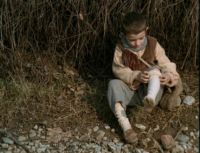
In the Lombardy region of Northern Italy during the last years of the 19th Century, one married couple among the peasants who lived there found that they had a chance to advance themselves in life - or at least one of their young sons did. It was suggested to them that little Minec (Omar Brignoli) was ready to go to school, being as intelligent and capable as he was, and although his father (Luigi Ornaghi) pointed out that he never had to go to school when he was Menic's age, and besides, the schoolhouse was six kilometres away, the Priest told him that the boy was strong and was quite able to make the journey there and back...
That's not only what The Tree of Wooden Clogs is about, but that's one of the reasons the film ends as it does, with a riproaring, kneeslapping laugh riot of gargantuan proportions - oh, wait, wrong film, this is a far more muted propsect for those looking for entertainment. A winner at Cannes, this comes across as the epitome of the kind of art film being released in this period, wth its three hour long running time, its politicised view of the underprivileged, and its determination to eschew any scene that might set the pulse racing, all with suitably noble intentions. Writer and director Ermanno Olmi grew up with these people, after all.
So that indicated he was going to stay as authentic to what their experience would have been, and it appears would have pretty much stayed well into the twentieth century. To those ends, Olmi cast not professional actors, but actual peasants from the region where he was filming, encouraging them to perform as realistically as possible through improvisation; also known for his factual works, it was as if he was trying to make a documentary of this way of life which if he could not visit due to him not being a time traveller, he could recreate as the next best thing. The effect has been described as either immersive and beguiling, or alternatively utterly soporific, such is the lack of incident.
The latter opinion is not quite fair, as there is plenty occuring here, it's just that it moves at a gentle pace all the better to reflect the slow forward motion of the era it depicts. Most of this is centred around the family that Menic belongs to, but we do get a good look at the community as they gather for such occasions as Christmas, working in the fields, or even an evening of the telling of tales (where it turns out the one we hear is indeed old enough to belong to this century). Interwoven with the overall narrative where the seasons change and the people's activities reflect that, there are other subplots, ranging from the somewhat silly (such as the one about the coin) to the far more affecting.
Well, you would be more affected if Olmi didn't observe this with such a bland gaze, as he may bring out injustice to our attention, but he never comes across as outraged by these events, more accepting, cautiously hopeful they will work out. The title comes from the part where Menic breaks his left clog while walking home from school, and because his father wishes him to continue his education he illegally chops down a tree belonging to his landowner to make a new one. This will have repercussions for the last act of the film, where the Marxism of the themes, very much in sympathy with the working man (and woman) are highlighted, yet curiously the Catholic Church is an establishment which is depicted as believing it has the best interests of the peasants at heart, even if it doesn't approach this in the right way. If you like the Marxism, then you might not like the Catholicism and vice versa, yet this doesn't make you ponder excessively over either, which could be viewed as a flaw if watching the poverty-stricken struggle through isn't solely to your taste.