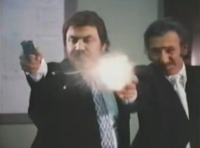
A couple of men, who look respectable enough in their suits, enter an office block and take the elevator to the floor they want, then approach the reception where the secretary there is told they want to talk with her boss. She sends them in, but the boss, a wheelchair-bound man, is not best pleased to see them, especially when they tie him to the chair, take him to the toilets, put one foot in the urinal and hook him up to the mains, whereupon they throw the switch, thereby electrocuting him. As if that were not enough, they then proceed to brandish guns and kill every single person there - all in a day's work for Mimi Miceli (Duke Mitchell)...
This was a far cry from pretending to be Dean Martin in Bela Lugosi meets a Brooklyn Gorilla, but Mitchell had amicably separated from his comedy partner Sammy Petrillo by the time The Executioner was made, and now had something to tell the world in the light of what The Godfather had brought to the public consciousness about the Mafia in America. Due to bad distribution, this was little seen, and when it was you took your chances on which title it would be under, with Massacre Mafia Style apparently writer and director Mitchell's preferred moniker for his magnum opus. Yet for those who did catch it, it's safe to say they did not forget it.
The influence of the far higher profile Francis Ford Coppola epic extended to taking the subject painfully seriously, but as far as Mitchell was concerned, his movie spoke the truth about the gangsters in a way that the blockbuster simply did not. Certainly he set about recreating the anecdotes he had heard over his time in the lower echelons of showbusiness with great dedication, and the fact that this was filmed on the cheap, without any gloss or prettifying, does mean it feels a lot more authentic to what it must have been like to be a crime boss in the seventies. Mitchell plays that crime boss as if aiming for the Oscar glory that The Godfather received, apparently unaware of the movie's shortcomings.
As this was based on the war stories he had collected, the construction can best be described as episodic, and after a while you find yourself waiting for the next burst of grottily-filmed violence. What happens is that the proudly Italian-American Mimi travels from New York to Los Angeles with the hopes of building his crime empire there, and he does so essentially by intimidation, committing acts such as the massacre we see at the beginning (which oddly is accompanied by Mitchell's upbeat nightclub crooning). Along the way he picks up a moll in the shape of Liz (Cara Salerno), who provides the nudity as well as the love interest, and makes unconvincing inroads into the underworld of the City of Angels.
Not unconvicing because you don't accept such things could ever happen, only because Mimi only seems to have two people working to his plans. But what successes they have, sending a finger through the post here, crucifying a pimp on Easter there, scheming to clean up in the porno movie market and all the while sentimentalising about how hard it is to pursue their chosen career paths. Mimi, who kisses a lot of men during this movie, has an impassioned speech near the end that complains of how the old ways, that presumably far more upstanding form of gangsterism, have fallen away and society is going to the dogs, which is fairly rich coming from a racist, sanctimonious and lawbreaking character who has killed more people over the course of eighty minutes than many have had hot dinners. Yet there's a weird sort of inegrity to the enterprise, not due to the hoods it depicts, but due to the filmmakers' oblivious belief in their work. Not a good film, then, but memorable. Mitchell provided the music, too.