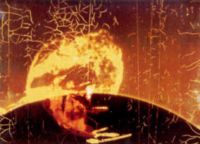
We begin with the dream the man had the night before as images swirl and tumble through his active but dormant mind, images of the landscape he lives in with its snow-covered forests and mountains, the clouds racing, then sluggishly crawling through the sky, and of his pet dog who is his main companion in this wilderness. Colours and the briefest of memories slip by, memories of his lover, of his family, of the streets at night, and of pictures so obscurely presented that we cannot be certain of what it is, precisely, that we are seeing...
And that's just the half hour Prelude. Our director here was perhaps the King of avant garde filmmakers, Stan Brakhage, and Dog Star Man was probably his most famous, most celebrated work, a film split into five parts of varying length and all intensely personal to him, so much so that often it would feel like an intrusion to be seeing something so intimate if it hadn't been Brakhage himself inviting us in to take a look and draw out conclusions. His regular theme was that we should be watching this as if we had no prior recognition of this imagery at all, so that we could view it with fresh, virginal eyes, which may have been odd in that he was already pretty sure of what it all meant to him.
That being that we were experiencing something primal played out on the screen, something that tapped into the myths and religions that all humanity were familiar with and therefore bringing that interpretation to bear on Dog Star Man whether we were conscious of it or not. Now, that's all very well in theory, but how many casual viewers would be thinking, why, that was straight out of the Norse creation story or somesuch when faced with a few shots of a tree being uprooted? Of course, if you did decide to watch this then a measure of dedication would come into play, so you could fairly argue that there were very few casual viewers of this work at all as you would probably know what you were getting into before you sat down with it.
Yet that does not mean that you couldn't simply let it all wash over you, as if appreciating a dream that you can only half-understand. For some the temptation would be to react like Mel Brooks' grouchy moviegoer in the Oscar-winning cartoon short The Critic, muttering that you did not know what was going on but you were sure it was dirty, and Brakhage did indeed include some startling shots of a sexual nature as well as some "how are we supposed to react to that?" glimpses of such things as a lactating nipple. But this was not abstract visuals for the sake of it, as if anything came across it was the artist's sincerity, almost to a fault as a lack of self-conciousness in what he presented could operate both as a benefit and a drawback.
Watching Dog Star Man now, you do take away a sense of struggle, no, not a struggle to grasp what is going on, but the struggle of the man who is depicted throughout. He exerts himself with Herculean effort to get up that mountain to gather his firewood, and Brakhage makes it even more difficult by tilting the camera on one side to make it look as if he is climbing up a sheer face of snow (the dog doesn't appear to have quite as much trouble). It all builds to an apocalyptic finale, with shots of solar flares bringing a cosmic aspect to the tale, and although you could be forgiven for missing that part the tone of getting to the heart of something profound about life, including footage of an actual heart beating, makes this enriching if you're willing to immerse yourself in it. Alas, something else you conclude from it is how a million rock videos have used it as inspiration: there is no soundtrack here, but as you watch you might find something doomladen surfacing in your mind's radio.