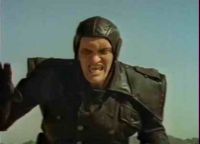
In the far future, the evil Lord Graal (Ivan Rassimov) has escaped from a maximum security prison with his mind set on conquering the known universe. To that end he has recruited the crazed Doctor Kraspin (Arthur Kennedy) who has devised a method of creating "humanoids" capable of enormous destruction, but first they must steal the element crucial to the process, so Graal sends his forces down onto Metropolis, formerly known as Planet Earth, to do so, and kill the scientist and teacher Barbara Gibson (Corinne Clery) into the bargain...
When the world was still waiting for George Lucas and his team to finish The Empire Strikes Back, there was no shortage of pretenders to his pulpy sci-fi throne, and one of those was The Humanoid, an Italian effort which history has judged to be somewhat lacking compared to its main rival Starcrash, which was released at the same time. Not that anyone thinks Starcrash was much of a threat to the Star Wars franchise, but it is a lot of science fiction fans' guilty pleasure, whereas The Humanoid lies neglected and if noticed at all, it's usually to sneer with derision at it. Perhaps the main reason for that was its slavish adherence to what made Star Wars distinctive, and how wide of the mark it was in recreating that success.
But let's not cast this aside without giving it some due, as while its leaden pacing did tend to diminish any excitement levels it might have contained had it been snappier, there was a measure of amusement to be gained here. For a start, it gave the starring role to Richard Kiel, the giant sized character actor who was more used to playing the heavy, and sort of did here only he also got the opportunity to be the nice guy as well, as we can see in the way he treats his pet dog. Well, not a dog exactly, more a plastic motorised dog-shaped robot in the R2-D2 mould, only even less animated if that were possible, making Paulie's birthday robot from Rocky IV look like The Terminator.
There's a lot of that "not as good as the original" material in The Humanoid, but for some that's part of the fun. Take Lord Graal, for instance: he is dressed like Darth Vader, complete with helmet, only instead of having his face entirely covered, he wears what can only be described as a bondage mask - come on, Graal, there are children going to see this. Not only that, but his missus, Lady Agatha, is played by Barbara Bach with a hairdo that has seemingly been patterned after the Vader helmet as well, not a look that really suits such a glamorous actress. Is it significant that when Flash Gordon arrived the next year that the Italians finally got this right, whereas here they simply seemed second hand and second rate in their chasing of the Star Wars millions?
For some reason a few of the actors here were involved with the James Bond series, with Kiel in instalments alongside both Bach and Clery, but more impressive was that according to the credits, this was directed by George Lucas! No wait, it was George Lewis, who was actually seasoned thriller deviser Aldo Lado here displaying what could best be described as a journeyman approach, although his second unit was carried by the go-to guy for blowing things up in Italian movies, Enzo G. Castellari. On soundtrack duties was an even bigger name, Ennio Morricone, who alas provided one of his worst ever scores, so much so that you can hardly believe it was the great man supplying it.
If that array of cult talent was not enough, there was also Antonio Margheriti fashioning the special effects, which didn't look to have moved on much further from his days back in the sixties when he helmed his own space operas. So what were you left with? Kiel, weirdly looking like Quentin Tarantino facially, gets turned into the humanoid of the title and goes on what resembles a drunken rampage, Clery is tutored in mysticism by her own pupil, and thereafter exists mainly to be saved, and the whole thing ends with an out of character bout of violence complete with burnings, decapitations, and a woman rotting before your very eyes. But worry not, the robo-dog mades it through to the end of the film, thanks apparently to it moving so slowly that nobody bothers with it until the climax. Call it senseless enough to be diverting, but not anything you'd mistake for high quality.