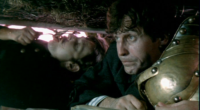
Jozef (Jan Nowicki) is travelling to a country sanatorium to visit his ailing father, but there's something not quite right about his journey there, and he is unsettled for the duration. He asks the conductor, who may or may not be blind, about his stop, and gets into a brief philosophical conversation with him that does little to reassure; then the carriage comes to a halt and Jozef gets out. The sanatorium itself is a crumbling old building that he finds it easier to enter through a large open window than the front doors, but once inside he has difficulty locating his father until he encounters a nurse who has a terrible truth to tell him...
In the West, writer and director Wojciech Has is probably best known for the twists and turns of The Saragossa Manuscript, but if you thought that was hard to follow, you evidently haven't seen The Hourglass Sanatorium, also known as Sanatorium pod klepsydra if you were Polish. Perhaps the epitome of the kind of art film that a certain type of viewer was happy to get stoned to, here any obvious plot is eschewed in favour of some dizzying though linked sequences, whose confusion is excused by the doctor looking after Jozef's father, who explains that he has managed to alter time to keep the old man alive.
The result of that is that Jozef becomes unstuck in time as well as all the other characters we see in the place, running through his memories apparently at random as he travels backwards through his life, and the life of Poland, while still staying the same age and doing his best to, well, act natural for want of a better phrase. It's not a surprise to learn that there are many who watch this so baffled by what they are seeing that they give up trying to make sense of it and sit back to enjoy the arresting imagery, but there is a kind of sense being made here, it's simply that you need to study the film to make it out. Of course, not everyone has the inclination to do so, making the option to let it all drift by an attractive one.
Due to the Polish society being what it was in the early seventies, and the upheavals it had gone through over the period that Jozef remembers and witnesses playing out before his eyes, many have seen The Hourglass Sanatorium as some kind of allegory for the Holocaust perpetrated by the Nazis. After all, the film was based on the writings of Bruno Schulz, a surrealist, for want of a better term, murdered by the Gestapo during the Second World War, and Poland was an occupied location which would not have been much talked about under the Communists. Yet while there are elements of the persecution of the country's Jewish population, this take on the story doesn't entirely fit.
You could just as easily see it as a satire on the Communist era, what with the suffocating bureacracy that Jozef experiences and at times participates in, so really the film is far more encompassing of Polish history than one event, as harrowing as that was. You could go through this picking out parts that took your fancy and not allow the Nazis or their successors to trouble your thoughts, watching for the clockwork men, the wax museum, or the black soldiers from decades before who are on the hunt for deserters. Indeed, Has appears to welcome a cosmic sensibility as the placing of anyone at any point in time comes across as being the sum of an existence, with Jozef struggling to come to terms with the realisation that existence will end, either for his father or for him. It's an entrancing experience, but flawed in that it's so wrapped up in itself many will find it hard to relate to in spite of its attempts to reach out to life as we live it, both consciously and unconsciously. Music by Jerzy Maksimiuk.