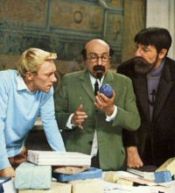
Young reporter Tintin (Jean-Pierre Talbot) is watching television with his good friend Captain Haddock (Jean Bouise) at their home in the Captain's country house, Marlinspike Hall. They have tuned into this programme because the guest on it is Professor Calculus (Félix Férnandez), their other good friend, who is outlining his plans for solving the world hunger problem by making deserts fertile for growing crops. The next day, there arrives in the post a flood of letters from interested parties, but what most intrigues the Professor is a box containing a blue orange: could this be what he has been looking for?
Not any old blue orange, of course, but one which glows in the dark to boot, and the note included tells them that it has been sent by a fellow scientist, Professor Zalamea (Ángel Álvarez), who has the ideal plant to farm on Calculus's newly reclaimed land. This being a Tintin story, all does not go to plan and soon the orange has been stolen, both professors have been kidnapped, and he and Captain Haddock follow the lead to Spain, which is understandable when you learn that this second Tintin live action outing was a co-production with that country. So in the spirit of Hergé's original comic books, the heroes venture to an exotic location, but don't venture anywhere else once they reach it.
There was an obvious attempt to appeal more to children this time around, more so than in Tintin and the Mystery of the Golden Fleece, which meant that a gang of helpful Spanish kids are part of the plot and take up frankly too much of the screen time you'd rather was being spent with Tintin and company. This was overall not quite as sprightly as the first instalment, as it became bogged down in the espionage angle around the middle and didn't quite recover aside from a scattering of bright laughs, but even so, for a film that was not based on an Hergé book and was an invented facsimile of one, the filmmakers didn't do too badly a job, and they certainly packed in enough action to keep the audience diverted.
As before, the characters in the film are neat representations of the ones from the page, with Jean-Pierre Talbot again filling the lead role with athletic aplomb - he only made these two films in his career before turning to teaching - with newly-cast Jean Bouise making for an acceptable Haddock, and yes he does call someone a "Bashi-bazouk" amidst his customary stream of inventive swearing. The Captain makes a meal of how much dashing about he has to do, but after a while you do see his point as the script seems to substitute pursuit for plot a little too often. He doesn't even get a decent drink for his trouble, as even when he does track down a bottle of whiskey, on putting ice into it he's in for a surprise.
That's because the ice is actually a recording from Professor Zalamea, although precisely how that would work is a mystery never cleared up; there's a more fantastical flavour to the adventures than in the previous film, but not so much that it overpowers the more tradtional thrills. Other characters from the books turn up too, not only the loyal Snowy but Thompson and Thomson as well, though quite what their purpose could be is a riddle that the scriptwriters did not bother to explain: they do supply a genuinely funny punchline to the story, however. Even Madame Castafiore (Jenny Orléans) appears, saving our heroes in their moment of need and providing Haddock with a headache of irritation, a nice touch if not really relevant to the plot. As a Tintin adventure, Blue Oranges is too by the numbers, but it's accomplished enough for the fans. Music by Antoine Duhamel.