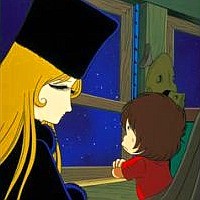
One-thousand years in the future, when most of mankind have swapped their humanity for immortal mechanized bodies, young street urchin Tetsuro Hoshino (voiced by Masako Nozawa) dreams of buying a ticket to ride the Galaxy Express 999. This amazing space train can travel anywhere across the universe and crucially reach the Mechanization Homeworld where Tetsuro hopes to acquire a robot body and take revenge upon Count Mecha (Kikai Hakushaku), the psychotic cyborg who killed his mother (Miyoko Asou) for sport. While escaping robot police, Tetsuro meets beautiful, mysterious Maetel (Masako Ikeda), an enigmatic time-traveller who uncannily resembles his late mother. She offers him the chance of a lifetime: a journey aboard GE999 as her travelling companion. Together they embark upon a galaxy-spanning adventure and encounter wondrous worlds, great heroes and valuable life lessons before Tetsuro faces his destiny.
1979 was a landmark year in anime, with an array of groundbreaking movies and small screen serials capturing the public imagination. Eclipsing all others however was Galaxy Express 999 the grandiose space saga by Leiji Matsumoto that traumatised a generation with its gut-wrenching drama but equally taught them to look to the stars with wonder. It is the romantic heart of a sprawling tapestry that encompasses such other key Matsumoto works as PCaptain Harlock (1978), Queen of a Thousand Years (1982), Arcadia of My Youth (1982) and DNA Sights 999.9 (1997). That said, Daft Punk fans will know him best as creator of the music videos that eventually formed Interstella 5555 (2003), the unique sci-fi anime musical opus.
As in 2001: A Space Odyssey (1968), the vastness of space is the backdrop for ambitious themes: destiny, dreams, youthful ideals and aspirations. Like all great stories, it’s not the destination but the journey that matters. Tetsuro’s life-changing journey teaches the young hot-head how life is finite and should be lived to its fullest, imbued with kindness and consideration for all living things. Equal parts Buddhist and Shinto in concept, this implies Matsumoto is harking back to another great Japanese fantasy, and later classic anime, Night on the Galactic Railroad (1985) based on the novel by poet Kenji Miyazawa. Killing Count Mecha inside his Hammer horror castle (that disappears and reappears across space somewhat like the fortress in Krull (1983)), where Tetsuro discovers his mother’s severed torso is a trophy mounted on the wall (told you it was traumatic!), becomes only half the battle. His quest changes from the desire to possess a robot body, to destroying the Mechanization Homeworld so mankind can regain its humanity.
It’s a story told with real cinematic panache by co-director Rin Taro, the Michael Curtiz of anime. Woven into the journey is a strain of Dickensian social commentary, ingenious concepts worthy of the greatest science fiction writers (lookout for the hand-held computers that anticipate the Blackberry or I-phone, and on a more superficial level: Tetsuro’s rocket-powered tricycle!), a whimsical imagination in line with classic fairytales and enough shootouts and space dogfights to satisfy any avid Star Wars fan. Nostalgia addict Leiji Matsumoto creates an old-fashioned oriental express that masks a super hi-tech spaceship, staffed by the lovable pint-sized Conductor (Kaneta Kimotsuki) (a pair of glowing eyes beneath a uniform) and the unforgettable Crystal Claire (Yuko Asagami), cursed with a fragile body and working to buy back her human form. Lovely in every sense of the word, Claire becomes Tetsuro’s first love and makes the supreme sacrifice amidst the heartbreaking final confrontation between good and evil, embodied by the wicked Queen Promethium (Ryoko Kinomiya), ruler of the Mechanized Empire.
Indeed all the talismans that mark Tetsuro’s journey from boy to man are women: the fearsome pirate queen Emeraldas (Reiko Tajima), Clare of course, the spooky yet faceless and pitiable Shadow (Toshiko Fujita), Count Mecha’s tragic musician girlfriend Ryuzu (Noriko Ohara), and especially Maetel. Gorgeous, willowy and blonde, she is Tetsuro’s love, his mother, his best friend in a relationship that is part adolescent dream, part Freudian nightmare. Whether angel, witch or death itself, Maetel is an enigma - the ultimate incarnation of Matsumoto’s ideal, if ambiguous, heroine - one whom the Nouvelle Vague fan allegedly modelled on French icons Jeanne Moreau and Catherine Deneuve.
Matsumoto has a wholly unique art style that places squat, potato-headed characters, akin to those drawn by Charles Schulz, amidst his richly detailed technological wonderland. The message being these are ordinary, vulnerable schlubs, out of there depth amidst these amazing ethereal women and larger-than-life heroes, but every bit as important. His most iconic hero, Captain Harlock (Makio Inoue) makes a great entrance where he swaggers into a bar and forces a gang of violent thugs to drink a gallon of milk. However, it is Harlock’s best friend, pint-sized genius engineer Tochiro (Kei Tomiyama) who makes the most lasting impact on young Tetsuro. Dying of tuberculosis and searching for a way to make his soul immortal, Tochiro is Tetsuro’s cautionary future. To underline the point it is his mother (Shoko Tsuboi) who passes on his Clint Eastwood-style hat, poncho and awesome Cosmo Dragoon Pistol, the most powerful handgun in the universe (only three exist: one belongs to Harlock, the other to Emeraldas), to our young hero.
By the story’s end a single glass tear embodies all the hope and goodness in the universe and the Galaxy Express departs into the sky taking Tetsuro’s youth with it. Ah, but that wasn’t quite the end as our heroes returned for the super short movie Galaxy Express 999: Through a Glass Clearly (1980) and a bizarre cameo in live-action monster movie Super Monster Gamera (1980), before a proper sequel arrived with Adieu, Galaxy Express 999 (1981), a movie many consider a masterpiece. The gorgeously romantic music by Nozomu Aoki includes so many songs - including J-pop ditties by interracial band Godiego (who were everywhere in the late Seventies, most famously performing the theme for Monkey) - that Galaxy Express 999 almost qualifies as a musical. “See you in the stars!”