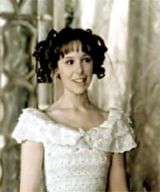
Several years ago a prank-loving magician (Oleg Yankovsky) turned a bear into a handsome young man (Aleksandr Abdulov). Now the bear is weary of life as a human being and begs the magician to change him back. The magician’s feisty, good-hearted wife (Irina Kupchenko) hates seeing any animal suffer and begs her husband to undo his spell. But the magician impishly replies only a kiss from a beautiful princess will change him back into a bear. Whereupon a bumptious, oafish king (Evgeni Leonov) and his entourage visit the magician’s house. Sure enough his lovely, clever and spirited daughter (Yevgeniya Simonova) falls for the handsome stranger and asks him to marry her. Equally in love, but fearing his transformation will break her heart, the bear spurns the princess and flees. Confused and dejected, the princess disguises herself as a boy and runs away to become apprentice to a melancholy hunter (Vsevolod Larionov), but the magician is not done with them yet.
Anyone expecting something along the lines of The Singing, Ringing Tree (1957) may be surprised. This Soviet-era musical fantasy, the second screen adaptation of a play by Yevgeni Shvarts, differs from most other East-European fairytale movies. Writer-director Mark Zhakarov - himself a celebrated playwright - tells his story in very avant-garde fashion, with action confined to interiors like a Chekhov play, albeit with enchanting and often ingenious visuals and a streak of absurdist comedy akin to a gentler Luis Buñuel. As various lovelorn, troubled or humorously self-deluded characters congregate at the magician’s house to air their anxieties the film resembles something like a Stephen Sondheim musical. There’s the First Minister, a Chaplinesque tramp whom no-one takes seriously, but who longs for the courage to stand up for his convictions. The Court Dame (Yekaterina Vasilyeva) who flatters and fawns over the tyrant king, yet secretly pines after her lost love. And there is the suave, yet oily Minister Administrator (Andrei Mironov), ostensibly the villain of the piece. Deeply pessimistic, with no respect for love, honour or any living thing, he schemes after the princess but isn’t above making a pass - in song, naturally! - at the magician’s comely wife.
The film grows a little repetitive as the lovers find each other and separate time and again, and drags as we wonder why Bear waits so long to tell the princess the truth. However, it eventually becomes apparent that the magician, who behaves exactly like a writer (dreaming characters into being, manipulating events, anticipating what people will say), is deliberately prolonging the story. It becomes an allegory not just for the game of love with all its hopes, fears and learning to trust, but for the creative impulse. Of falling in love with one’s characters, but eventually having to say goodbye with a definitive end, or else the story has no meaning. The closing image of the magician all alone in his crumbling house is quite poetic. Though it has an underlying streak of melancholy, the film is often playful and witty including a joke previously used in both Once Upon a Time in the West (1968) and Blazing Saddles (1973), where characters realise the hero is approaching because they hear his theme music. The music composed by Gennadi Gladkov, with lyrics by Yuli Kim, is lovely although the main theme bears a surprising resemblance to the string section of Monty Norman’s James Bond theme.