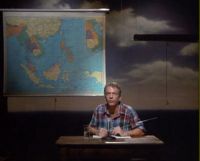
Spalding Gray, an actor, sits himself down behind a desk in front of an audience, takes a sip of water, and begins to speak. For the next eighty minutes, he spins a few yarns about his time spent in Thailand where he had been hired to appear in a supporting role in the film The Killing Fields; you might not have remembered he was in it if you've seen the movie, but if you watch it again after viewing this then you're not likely to forget him. Into this monologue about his experiences in the Far East, he brings out the politics of the area, much as the film he had appeared had, although from a far more personal outlook...
When Spalding Gray committed suicide his death received a few minor headlines around the world, but it was not front page news; however, for those who had enjoyed the one man shows he had put on, and if they had not caught them then had appreciated the films of those shows, the story felt like a genuine loss, as he had poured so much of his personality into those works that it was easy to feel as if you had met him. Not only met him, but had an intimate conversation with the man where he had regaled you with some terrific anecdotes and offered an insight, as keen as it was witty, into the way society works across the planet.
Although Gray made other monologue films, the one he is likely to be recalled for was Swimming to Cambodia, which mixed in true life, first hand tales with a history lesson about exactly how the Khmer Rouge gained a hold in that country during the nineteen-seventies. Initially, his language seems dense and self-involved, plucking analogies hither and yon and skipping from narrative to observation, but after a while you come to realise precisely how lucid a thinker Gray was. Once you have settled back in your chair and are allowing yourself to go with the flow of his conversing, the imagery he conjures in your mind is almost as vivid as actually seeing what he describes.
In the United Kingdom, this film was given an 18 certificate, which may surprise those who have not seen it as it is well known for depicting one man talking, with no dramatisations - the short clips from The Killing Fields he was in apart - and certainly no sex or violence. But his language does turn explicit at times, and the part where he goes into detail about how Bangkok has turned into a city-sized whorehouse has the power to raise eyebrows, especially when he describes the nightclub act with the ping pong balls and the banana (earlier, he says the part with the fruit hitting the wall is the only part of the talk he has invented).
Yet those sections are more intended to amuse as it is the descriptions of how Cambodia was transformed into a land where children were killed in front of their mothers and vice versa, or you could be murdered for wearing glasses, that are truly obscene. Gray fully admits he did not know the first thing about the history of the place other than what he had seen on the nightly news, but you can tell that he did a lot of learning when he was out there, and not simply down to the supposedly top class marijuana he sampled out of a curious tourist's duty which gave him such a terrible reaction.
In a lesson that never seems liike a digression, we are informed the Americans forced the Viet Cong over the border into their neighbouring country, started bombing them, the now-politicised Cambodians in those areas became the Khmer Rouge, and a new holocaust erupted with millions dead and no clear point to the deaths; for a film that relies so heavily on language, Gray ironically notes how it lets the rest of the globe down when they could not understand what was happening due to the verbal barriers. This is related with the use of a couple of maps and a clear head, with his story of meeting the naval officer who could start World War Three reminding you this was the eighties through and through. Other, more personal aspects are woven into this tapestry so that this film stands as a testament to a master of his craft, funny, enlightening and sharp. Music by Laurie Anderson.
American director with a exploitation beginnings who carved out a successful Hollywood career as a caring exponent of a variety of characters. Worked in the early 70s as a writer on films like Black Mama, White Mama before directing his first picture for producer Roger Corman, the women-in-prison gem Caged Heat. Demme's mainstream debut was the 1977 CB drama Handle With Care (aka Citizens Band), which were followed by such great films as the thriller Last Embrace, tenderhearted biopic Melvin and Howard, wartime drama Swing Shift, classic Talking Heads concert film Stop Making Sense, and black comedies Something Wild and Married to the Mob.
Demme's Thomas Harris adaptation The Silence of the Lambs was one of 1991's most successful films, making Hannibal Lecter a household name, while the worthy AIDS drama Philadelphia was equally popular. Since then, Demme has floundered somewhat - Beloved and The Truth About Charlie were critical and commercial failures, although 2004's remake of The Manchurian Candidate was a box office hit. Rachel Getting Married also has its fans, though Meryl Streep vehicle Ricki and the Flash was not a great one to go out on. He was also an advocate of the documentary form, especially music: his final release was a Justin Timberlake concert.