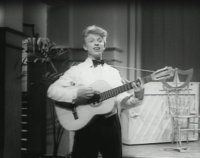
Tommy Steele (as himself) has just come off stage after a barnstorming night at the famed Cafe de Paris in London, and there are a group of journalists waiting in his dressing room who have a lot of questions for him. They have so much to ask that Tommy decides to make things simple and regale them all with his life story, and so they sit in rapt attention as he recalls his teenage years in Bermondsey, where a judo class set him on the course to fame. Not that he became a celebrated judo exponent, but an injury confined him to hospital where a lot of spare time left him with the opportunity to learn guitar...
Cliff Richard was not Britain's first rock 'n' roll star, it was Tommy Steele who took that proud claim, and here, not even half a year after he became a star, his life story was filmed, with very little to jazz it up in terms of showbiz pizazz. Actually, it looked as if it was shot in a couple of days and in a couple of corners, with Steele performing largely on his own with the help of a mysteriously invisible band whose rhythms drift in from the ether to back him and his guitar (and on one occasion not even that). It's the rags to riches tale stripped down to its very basics, as if the producers knew the audience were happy to see their idol no matter the quality of his material.
This was made by some of the team who would strike a goldmine with the Carry On comedies, but Carry On Sergeant was a year in the future and here producer Peter Rogers and writer Norman Hudis (who would go on to script for The Man from Uncle and Buck Rogers in the 25th Century) were taking as their main aim to make a fast buck out of the rock craze before it went the way of skiffle. Not that there was no skiffle in this film, as it climaxes with Steele introducing a concert featuring a variety of bet-hedging acts such as the Chas McDevitt band and Nancy Whiskey performing the bittersweet and charming Freight Train, a big hit in this year.
Humphrey Lyttelton appears too, playing his trumpet as the U.K.'s ambassador of jazz, although he doesn't get any lines, so no double entendres, I'm Sorry I Haven't a Clue fans. Fans of Tommy are better catered for, as he performs a tune practically every five minutes, although only one of them, A Handful of Songs, is really recognisable all these years down the line. Whereas in American movies of the day rock singers were true rebels to appeal to the teenage audience, here Tommy is a well-brought up boy who only shows his rebellion when he goes to sea and takes up his vocation as a singer.
In this way, he can be seen to be fighting the system, man, essentially by belting out a song or three to inadvertently annoy the ship's head steward which gets him sacked, but it's clear there's no malice intended on our hero's part, as Steele is presented as unassuming and modest throughout. His doting parents are not people he has any arguments with, the closest they come to doing so is when he announces to them he is getting his money by playing in a coffee shop, which was a genuine way to get discovered in those days, unlikely as it may sound now. This film's main strength is in its friendliness, as it has no villains and simply exists to promote its star and his recording career. No rough edges to Tommy are apparent, even if there are in the penny-pinching production, but then, what did they really need to spend a lot on? Tommy and his guitar were enough to bring in the punters.