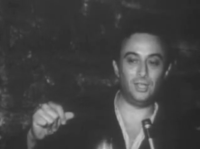
Controversial stand up comedian Lenny Bruce died in 1966, but there was one recording of his uncensored act on film, and that was his next-to-last performance which took place in a San Francisco nightclub, one of the few venues left in America that he was still allowed to appear in. By this stage he had been on trial three times for obscenity, winning his first case which was in this city, but losing the following two, although the verdict of the second was overturned on appeal. Here he obsessively goes over the details of his most recent court case in an attempt to explain himself to an appreciative audience.
Of course, by this time Bruce would have been forgiven for losing his sense of humour, and it's true that there are damn few belly laughs contained in this, the main visual capture of the man at work. At times it's as if the legendary comic is offering us a lecture on what he feels is so wrong about the transition he went through from so-called "sick comedy" to outright lawbreaking, and why his accusers were so far off the mark in their pursuit of him. He puts forward a very persuasive case, which is only too obvious after the amount of time he had to think over his act and thus defend himself against the law.
For what did Lenny really do but blaze a trail for the kind of comedy that can be heard in many clubs and theatres, and is even seen on television to little public outcry? Yes, watching him here may take some viewers aback who are not used to hearing his cursing-littered language, but it's not something that would be seriously considered as worth putting someone in prison for nowadays. So if nothing else we can thank Bruce for allowing standards to alter to the extent that cracking jokes about sex in front of paying customers is not an actiivity that should make the gag teller a fugitive from the authorities.
It all came too late for him, however, as within months of this film being shot, he was dead of a suspected drugs overdose, never knowing of how he had changed the world of entertainment, never mind free speech, forever. That's not to say this is an easy watch, as the camera is trained on Bruce throughout, following the spotlight as he nervily paces the stage, constantly referring to his notes, and all in bargain basement (for the sixties) black and white. At times it's hard to keep up with his outpouring of opinions, and by the end he sounds as if he is free associating, rattling off parts of his act that pop into his mind without concern as to how they all tie together.
Yet his point, for all the rambling, is clear enough: for those who wanted to hear his style of humour, they could gladly come to his shows or buy his albums, for those who didn't, there was no enticement and to listen to a policeman going over the parts of the performance which he thought might be deemed obscene in a court, understandably the punchlines might be somewhat lost on a judge and jury who would have had never dreamt of going to a Bruce show. It's as if he is offended himself, not by the charges so much as the way his material is debased in the retelling and adaptation for the trials: "look what they've done to my song", if you will. Therefore if it's possible for a stand up recording to be depressing, then look no further than this just-over-an-hour-long movie for proof; you can't help but feel sorrow for a man who was hounded so needlessly.