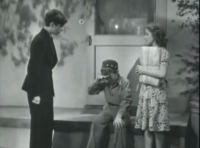
When John Pepper is killed in a tragic mining accident, his fifty percent share in a lucrative copper mine goes to his eldest daughter Polly Pepper (Edith Fellows) who, unaware of her inheritance, struggles helping to raise her impoverished family of four boisterous siblings, while their loving mother (Dorothy Peterson) works away from home. Business tycoon J.H. King (Clarence Kolb) is eager to trace the Pepper family, little suspecting they live but a stone’s throw away from his mansion. His good-hearted young grandson Jasper (Ronald Sinclair) has already taken a shine to Polly and befriended her siblings: Ben (Charles Peck), Joey (Tommy Bond), Davie (Bobby Larson), and little Phronsie (Dorothy Ann Seese). Mr. King soon inveigles his way into the household, hoping to trick Polly into signing over her shares. But when the kids come down with the measles, he and his grandson are quarantined with them in their little brown house.
Created by Margaret Sidney, the Five Little Peppers books were written between 1881 to 1916, spanning a period that saw young Phronsie grow from three years old into a young woman of twenty. These feel-good fables celebrated family values like hard work, humility and togetherness, and though the movies are not entirely faithful in terms of plot, much of their essential appeal remains intact. Columbia Pictures latched onto the Pepper stories, ostensibly as a vehicle for Edith Fellows, although the scene-stealing antics of little golden-curled Dorothy Ann Seese proved so popular she quickly rose to second billing.
Sixteen year old Fellows never became a huge child star but proved herself a versatile actress in classics like Pennies from Heaven (1936) and Hearts of the Rio Grande (1942), and later onwards in supporting roles on television well into the 1980s. She even popped up in the far less wholesome The Hills Have Eyes Part 2 (1984)! Fellows makes an endearing heroine and alongside her young co-stars provides the heart of a movie simplistic in plot and sentimental, but often honest and heart-warming nevertheless. Much of the opening third concerns the kids’ struggles to earn enough money to bake their mother a birthday cake. Coming at the tail end of the Great Depression, the film shows an impoverished family get by on guts, good sense and ingenuity, or else making the best out of a bad situation. When J.H. watches the compassionate, motherly Polly work herself to exhaustion looking after the kids and then succumb to illness, it melts his Grinch-like heart.
This story concludes with great changes ahead for the Five Little Peppers. One of the most likeable aspects of the original books is how being grounded in honest work and homespun values means the kids may run with an upper-class crowd but are always ready to lend a hand to anyone from all walks of life. This idealism is ever-present throughout the film series which remained in circulation for many years and were frequently scheduled for children’s film festivals and matinees. The Pepper kids would return in Five Little Peppers At Home (1940).