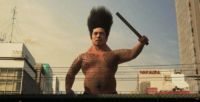
A fly-on-the-wall documentary crew follow Masaru Daisato (Hitoshi Matsumoto), an average Joe slacker going about his daily grind. Estranged from his wife (Shion Machida) and eight year old daughter, he lives alone in a cramped, messy home, and hangs out at the local noodle shop where he orders the same meal every day. Only the occasional brick slung through his window, hate mail, abusive graffiti and placards hung outside his door that read “You’re annoying” or “Fall Off A Cliff”, give any indication something else is going on. For you see, when trouble hits Tokyo, government agents strap Daisato into an oversized pair of purple underpants and painful nipple-clips that send the electric jolt that transforms him into Big Man Japan, a thirty-foot superhero with a high-top hairdo.
Every day he battles weird and wacky mutant monsters, such as the Strangling Monster (sort of an anaemic Michelin Man sporting a bad comb-over), the Leaping Monster (who sports the head of yakuza movie star Riki Takeuchi atop a single kangaroo leg), and the Evil Stare Monster (a wriggling eye stalk atop a hairy chicken body). Though his exploits are transmitted on weekly television, the public think him a pathetic, embarrassing nuisance for being too noisy and destructive. As if that weren’t enough, Daisato has an agent (Ua) intent on branding his naked torso with sponsor logos and an Alzheimer-afflicted grandfather running amok with similar super-powers. His sad, lonely life gets that much worse when, after losing a battle against a vicious red demon, he is caught on camera trying to run away.
It’s almost an unwritten law in Japanese light entertainment. Sooner or later a comedian or J-pop star makes a superhero spoof. “Beat” Takeshi Kitano did it with Getting Any Lately? (1995). The Drifters (Japan’s equivalent to The Goodies) donned spandex for their sixteenth film outing, Justice: Fighting the Good Fight (1975). Heck, even Takashi Miike made two superhero comedy vehicles for a popular boy band and girl group. Making his directorial debut, comedian Hitoshi Matsumoto is different. Along with partner Masatoshi Hamada, he makes up Downtown, the biggest showbiz act in all of Japan, famed for their zany, free-form improvised flights of fancy. Though Matsumoto’s use of the mockumentary format has led to inevitable comparisons with Christopher Guest, the off-the-wall surrealism and J-pop culture satire are entirely his own.
Driven by Matsumoto’s deadpan lead turn, Big Man Japan is more weirdly amusing than laugh-out-loud funny, accentuating the melancholy undertones. There are poignant episodes where Daisato takes the daughter he only sees once a month to the zoo and recalls how his grandfather saved him from his overzealous dad. Asked whether she likes her daddy, his daughter replies “I don’t know”, while his ex-wife quite reasonably resists subjecting the child to the same experiments that made Daisato a giant superhero. Later she cheerfully tells him (via video - ouch!), she has met someone new whom his daughter loves too. All of which makes this a curiously downbeat affair, despite amusing encounters with the giant squid-like Stink Monster who stubbornly refuses to move on (“I’ve been stinking up Tokyo for decades!”) and a randy, phallic-shaped monster who tries to mate on-camera, horrifying TV audiences across Japan.
Throughout the story, Matsumoto weaves his obvious affection for the golden age of tokkusatsu (“special effects”) shows in the Sixties, Seventies and Eighties, into a rumination on how what was once magical has grown mundane, commonplace and taken for granted. Newsreel footage shows his grandfather, Big Man IV, being feted by crowds and beloved. Daisato wearily admits there were more monsters in the old days and other superheroes fighting the good fight. Now he stands alone, an embarrassing, incompetent anachronism. It’s almost like The Incredibles (2004) re-imagined by Mike Leigh.
While a Hollywood movie would have made this an underdog makes good fable, Daisato remains a loser right up to the fadeout. He even accidentally kills grandpa trying to escape the red demon. It climaxes with a spot-on parody of Seventies superhero fare, as an Ultraman style family of giant superheroes called Super Justice arrive to give Daisato a helping hand. The surreal computer graphics give way to old-fashioned men-in-suits, muted tones are replaced by garish comic book colours. Despite being a parody, the sequence retains that sense of wonder prevalent from an era when heroes wove cartoon rainbow beams and soared into a blazing blue sky. It’s a charming sequence but between monster battles, Big Man Japan grinds along in pedestrian fashion and is just a little too downbeat to be much fun.