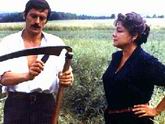
In the summer of 1934, a young man named Jean (Alain Delon) arrives in the French countryside and takes a job as a farmhand working for formidable widow, Yvette Couderc (Simone Signoret). Madame Couderc shares the farmhouse with her elderly, grumpy and deaf brother-in-law Henri (Jean Tessier), which proves the root of her feud with his scheming daughter Françoise (Monique Chaumette), who is eager to seize back what she sees as her rightful property. Gradually a warm friendship and casual romance blossoms between Jean and the older woman, which endures even after she discovers he is an escaped criminal, yearning desperately after a better life. However, Jean also takes a sexual interest in Françoise’s pretty daughter, Félicie (Ottavia Piccolo), who already has a baby son but trysts with the handsome stranger. Irked by these turn of events, Henri and Françoise visit the police…
Adapted from a novel by Georges Simenon, The Widow Couderc takes a largely grim view of French country life. Crucially, the tragic events unfold at a time when fascism was on the rise across Europe. Veteran director/co-screenwriter Pierre Granier-Deferre draws none-too-subtle allusions between the petty-mindedness, greed and betrayal displayed by the peasantry and the societal rift that ensued during the Nazi occupation, suggesting perhaps that such negative traits were always there and merely exploited by the Germans.
Granier-Deferre depicts a wholly exploitative society: as a young woman, Madame Couderc was raped by her elderly employer, made pregnant by his son, and now tends house and sexually services her aging brother-in-law. She latches onto Jean as her potential salvation, but with the odds stacked against them by self-righteous hypocrites like Henri (a self-pitying and despicable sort who feigns deaf when it suits him), there is no way out. It’s certainly an incisive story, even poetic at times, yet excessively fatalistic and something of a one-note tragedy when set beside the likes of Jean de Florette (1985).
Largely a slow-burning drama, with the bulk observing two taciturn characters circling each other, teasing out details of their pasts, the film gains much from its seasoned stars. Fresh off his biggest box-office hit, Borsalino (1970), Alain Delon excels as the stoic, yet almost childishly vulnerable Jean, who craves both the maternal warmth of the widow and the sexual satisfaction and promise of a better life offered by the nymph-like Félicie. Unlike Hollywood, French cinema allows its female stars to mature gracefully onscreen and offers strong roles, and so it is with Simone Signoret. One of the great style icons of French cinema - and the first to win an Oscar, for Room at the Top (1959) - Signoret matured into a formidable actress gracing screens well into the early Eighties. She brings great depth and poignancy to her role here. A great advocate for liberal causes, one wonders how she got on with the notoriously right-wing Delon, with whom she subsequently re-teamed in Les Granges brulées (1973).