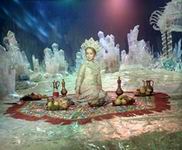
Gallant knight Ruslan (Valeri Kozinets) marries luminous princess Lyudmila (achingly lovely Natalya Petrova), but no sooner have they adjourned to their palatial honeymoon suite when a magical thunderstorm sees her abducted by a supernatural evil. She awakens to find herself captive inside the spectacular ice palace belonging to dwarf sorcerer Chernomor (Vladimir Fyodorov), whose vast powers and seeming invulnerability stem from his enormously long beard. Though the wicked magician courts her with jewels and various enchanted trinkets, Lyudmila has no intention of staying his prisoner and conceives her escape. Meanwhile, disgusted with his son-in-law, Prince Vladimir (Andrei Abrikosov) promises Lyudmila’s hand in marriage to whomever rescues her. Three rival suitors set forth, including sinister swordsman Rogdai (Oleg Mokshantsev), lazy, gluttonous Farlaf (Vyacheslav Nevinnyi), and “gallant khan” Ratmir (Ruslan Akhmetov), but Ruslan is resolute about retrieving his beloved. His epic quest brings encounters with vast stone giants, a wicked witch, malevolent forest spirits, mermaids and a helpful wizard.
Four years in the making, Ruslan and Lyudmila was the last film by Alexander Ptushko, the Russian animator/special effects wizard/fantasy filmmaker who passed away six months after the premiere of his magnum opus. Loosely based on the epic poem by Alexander Pushkin (itself a more fantastical extrapolation upon actual historical events), the film acknowledges its source with characters who speak in iambic pentameter and tips its hat to a more internationally renowned adaptation, Mikhail Glinka’s opera, extracts from which comprise part of the soaring score.
Often dubbed Russia’s Walt Disney, Ptushko has also been compared to Ray Harryhausen and Mario Bava, but arguably had greater range as a filmmaker, not to mention resources that outstrip even Harryhausen’s celebrated efforts. His early works were animated shorts, culminating in ambitious stop-motion features: The New Gulliver (1933), a reworking of Jonathan Swift’s satirical fantasy as an anti-Capitalist allegory, and The Golden Key (1933), an off-kilter adaptation of Pinocchio that predates Disney but takes off into steampunk science fiction. After the war, Ptushko embarked on a series of eye-popping fairytale epics, including Sadko (1953), released internationally as The Magic Voyage of Sinbad, but dabbled as proficiently in costume romance (Scarlet Sails (1961)) or horror (Vij (1967)) as in his preferred children’s genre.
Although pitched at the kiddie matinee crowd, Ptushko paints an epic canvas worthy of Akira Kurosawa or The Lord of the Rings, marshalling hundreds of extras in lustrous costumes and deftly spinning stories within stories that, as in One Thousand and One Arabian Nights (1969) or The Saragossa Manuscript (1965), interweave into a rich tapestry. His carnival of mostly handmade wonders - incredibly detailed miniatures, stop-motion special effects, surreal monsters, vast battles, circus animals performing tricks, and amazing sets from the crystalline ice palace swathed in candy-coloured fog to the vast golden lacquered chamber where Lyudmila is held captive (and taunted by parrots!), outstrip the CG photorealism of the Rings trilogy. Yet these images of jaw-dropping beauty are wedded to a story of real poetry and soul. Ruslan may think he’s on an epic quest to prove his might, but the story subtly reconfigures his odyssey into a series of lessons proving there is more to being a ruler than mere strength.
If the film does have a weak link, it is Ruslan, so stoic and resolute he comes across as a bit of a stiff. This is no fault of lead actor Valeri Kozinets, who plays heroic to the hilt and besides someone has to be the straight man amidst the craziness of cackling hags, hyperactive goblins and a tiger who chuckles heartily at the idea of eating human flesh! Meanwhile, Lyudmila is no simpering damsel but a gutsy heroine who valiantly fends off Chernomor and his army of green samurai monkey-men in a riotous action scene. She’s clever enough to sneak away with a magic turban that turns her invisible and compassionate enough to risk her life giving captive giants a drink of water. Certainly a princess well worth fighting for.
Originally released in two seventy-minute instalments, the plot takes surprising turns even after Lyudmila has been rescued, with an army of Tartar invaders upping the ante and a sleeping Ruslan beheaded by duplicitous oaf Farlaf (get out of that if you can!), but it all works without seeming convoluted and remains easy to follow for a family audience. Watch out for a sequence which must have influenced Monty Python and the Holy Grail (1975), wherein Ratmir is sheltered at a castle belonging to twelve beautiful, scantily-clad dancing girls who wait on him hand and foot - until he abandons them for a passing servant girl. There’s no pleasing some men.