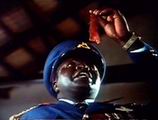
In the early nineteen-seventies, Ugandan President Milton Obote is deposed in a coup, and there is much rejoicing in the streets as General Idi Amin (Joseph Olita) takes his place at the head of the country. As a graduate of the European and North American-backed army, Amin is considered an excellent and malleable substitute by the British and French, but they do not realise that in supporting his regime they are making a mistake that will lead to thousands dead. For Amin is not a benign ruler, he is a power-crazed tyrant who swiftly begins to round up all dissenters and implement a reign of terror...
The Rise and Fall of Idi Amin, or Amin: The Rise and Fall as it was known in some areas, was a co-production between Kenya and Great Britain that many regard as a tawdry exploitation piece, cashing in on the public prurience about the horrors of the General's behaviour. Yet while there are gory moments, as you might expect with people being executed left, right and centre, all indications were that the filmmakers were sincere in providing a record of Amin's history, and for the most part the film resembles an educational special straying into the extreme.
Not that this makes what it depicts any easier to stomach, but what they chose to include ranges from the outright bizarre, such as Amin keeping the heads of his enemies in his fridge so he could hector them whenever the whim took him, to the nigh on comedic, as we see him in bed with two women at the same time and boasting of his sexual prowess (he calls himself "Big Daddy"). Yet there was a sense at the time in the Western press and media that this monster was a figure of fun, and there were many spoofs and gags at his expense even as the true nature of his evildoing became apparent. So with this movie, it walks a tightrope of sending up and bringing down the General.
Although it doesn't walk it too steadily, it has to be said. The main bonus the production had was a lookalike and soundalike performance in the person of Joseph Olita, who made a career of playing the dictator, if two films can be called a career. He is Amin to the life in this, drawing out the public figure that many found so easy to mock, whether sending his son out of the rally car he is driving to replace him with an attractive woman he stops the race to enjoy sexual relations with, or more notoriously cutting a strip of flesh from one of the bodies of his opposers and consuming it. If Amin really was a cannibal is hotly disputed, and you get the impression not much fact checking went into this film, but it makes for a lurid story and the film feels more interested in sensation than it is in, say, the expulsion of Uganda's Asians.
And yet, there's always a note of seriousness struck after every instance of absurdity, even if after a while the film comes across as a selection of highlights (or lowlights) of Amin's career in the seventies before he was forced into exile. The appearance of reconstruction after reconstruction means that there's little of the narrative progression about the way this plays out, and eventually it settles into providing all that stuff you've heard about and a few you might not have as if there was a checklist the producers had drawn up of what they wished to include. The other characters, based on life, are pretty much secondary to Amin, so there's a bit with arrested journalist Denis Hills who plays himself, and Thomas Baptiste as almost the main supporting character, a surgeon who is drafted into becoming Amin's personal doctor but is horrified to learn his brother has been one of the General's victims. The main problem here is that feeling of trivialisation, but the makers of this were not the only ones guilty of that. Music by Christopher Gunning.