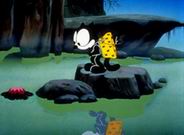
The Kingdom of Oriana is not in the real world, but in an alternative dimension, so we will never see it. Well, we won't, but Felix the Cat (voiced by Chris Phillips) will when his attention is drawn to it by the appearance of a floating tear which contains the image of the Princess Oriana (Maureen O'Connell) and implores him to help. You see, the Kingdom has been overtaken by the armies of The Duke of Zill (Peter Newman), a crazed and powerful scientist who means to control the land, and he has imprisoned the Princess. Now the only one who can help is the little cat, and he has a magic bag to assist him...
Felix the Cat was one of the icons of the 1920s, before Mickey Mouse came along he was a cartoon superstar with his short animated comedies and newspaper strips cementing his famous reputation. Alas, come the thirties and the sound revolution, he fell out of favour as fresher characters arrived, and people forgot just how innovative and groundbreaking he was; apart from a brief revival on television in the late fifties Felix has not enjoyed much success since. However, this film was intended to change all that, the brainchild of producer-writer Don Oriolo (whose name sounds suspiciously similar to that of the magic kingdom here).
The original Felix cartoons were always surreal in some way, but not in a studied manner, more of an organic, natural development out of the character's quirks and goodnatured ingenuity. Here, however, there is an attempt to plonk him down into a world that is already weird, almost a post-apocalyptic version of a fairytale land that suffers too many digressions into strangeness for its own sake without furthering the plot - did we really need to take a couple of minutes out of the action for a pair of tapdancing mice-lizards to strut their stuff, for example? This means that Felix doesn't appear half as much as he should.
And when he does appear, he relies so much on the magic bag that you wonder why Felix had to be in this at all, as you could simply follow the adventures of the enchanted portable container without the cat's presence being necessary. Of course, we needed a star, but what this actually looks like is an animated version of the Super Mario Brothers movie, ahead of its time but with the same lack of success. Whether this incarnation of Felix inspired that flop effort is unknown, but they do share a continuity in missing the point of their inspirations, although this was a far lower profile failure, barely getting a release and turning up on the odd TV channel to catch amusement-seeking children unawares.
There are halfhearted tries at making this a musical, but the songs never take and Felix never sings (of course, there are those who would have preferred that he had stayed silent and that this whole talking thing was a bad idea after the invention of sound film). The jokes are limited to the kind of humour that Hanna-Barbera might have found poor quality, along with instances of the frankly bizarre (a dragon doing Marlon Brando impressions? One for the kids, there, for certain). The storyline wends its way through so many random plot points that you wonder if they were trying to emulate the imagination of anime, but as this was animated in Hungary and not Japan that doesn't quite gel. You can see it entertaining the very young who are not aware of Felix's history, but as a tribute to him it falls flat when it really could have been any generic character starring here: he doesn't even take off his tail and use it as a cane! Although he does provide soul-destroyng product placement, which is no substitute. Music by Christopher L. Stone.




 Display comments