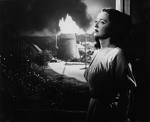
Loyalton in Wisconsin is a quiet town unless the hoot of the sawmill's whistle is sounding, but today it's quieter than usual as the streets are deserted. Why? It's because everyone in the town is at the courtroom where Rosa Moline (Bette Davis) is on trial for murder after what she claims was an accident. To understand the interest in this case we must go back a few months when Rosa had recently married the local doctor, Louis Moline (Joseph Cotten), and he had taken her on one of his frequent fishing trips. She was restless and dreamed of a new life in Chicago, but it looked like she was going nowhere fast - though that was not going to stop her scheming...
The word "camp" might well have been invented for Beyond the Forest, which plays like a John Waters movie if he had been making would-be prestige pictures for Warners: you can imagine Divine would have fit very well into the Davis role. On the subject of Bette, she made no secret of the fact that she hated this film, not only because of the derisive critical reaction after it was completed, but because she didn't wish to make it at all and nearly walked out on it halfway through. She was right in that she was about ten years too old for the role, and perhaps she perceived that this was not so much a film she could get her teeth into, but one which reduced her to parody.
Director King Vidor was going through a phase of overheated melodrama which has gone on to find fans in much the same way that Beyond the Forest did, but that didn't make Bette like the film any more, and the fact that it gave her a catchphrase - "What a dump!" - didn't help in that everyone thought she had overplayed in the original thanks to Elizabeth Taylor's impression of it in Who's Afraid of Vriginia Woolf? when if you hear her say it it's actually more of a weary, muted observation. Mind you, it is about the only part of the film where she Davis does underplay, as otherwise she shakes the life out of the role with a sneer, as if to exhibit her thorough disdain for the entire production.
Which naturally is what makes it so much fun to watch, with the star huffing around in an obvious black wig and snarling mouth caked in red lipstick, firing off her lines as if she's about to roar in despair at the rotten state she has ended up in. But oddly, that does not make Rosa unsympathetic as she is by far the most colourful creature in the film, whether she's taking shots at porcupines with a rifle (and hitting them with pinpoint accuracy!) or thinking up ways to land the rich businessman, Neil Latimer (David Brian), who she always wanted and has been leading her on somewhat. So while Rosa acts the villain, we can see that she's more the victim of circumstance in that there's nowhere she really belongs.
Not in the smalltown she grew up in, and not in Chicago as when she does finally arrive there (and after composer Max Steiner has absurdly shoehorned that city's theme song into every possible variation) she is as out of place there as she is back home. Neil makes excuses not to see her then rejects her, and in a ripely daft sequence Rosa is mistaken for a prostitute twice, is laughed at by two complete strangers and has a newspaper thrust at her by an overenthusiastic vendor - all in the pouring rain! No wonder she heads back to Loyalton, to the arms of Louis and the life of bored leisure being sniped at by her maid (Dona Drake). For all the amount of feeling you have for Rosa, bad girl that she is, it's true that you do spend too much of the film laughing at her predicament and her disgusted reaction to it. Still, she was a country girl at heart and if only she'd have admitted it to herself she might have been more content.