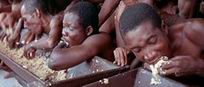
Quite possibly the most offensive and inflammatory exploitation epic ever made, this Italian-made “mockumentary” by Mondo Cane (1962) directors Gualtiero Jacopetti and Franco Prosperi supposedly started riots when it played grindhouse theatres along New York’s 42nd Street. The rather ludicrous conceit implies filmmakers Jacopetti and Prosperi have somehow time-travelled back to the 19th Century to dramatize the horrors of slavery in America’s pre-Civil War South, interviewing an array of monstrous plantation owners, slave drivers and hypocritically genteel Southern families as they torture, humiliate, rape and mass murder hundreds upon hundreds of African slaves.
“Oh My Love”, a treacly romantic ballad plays over sweeping aerial shots of the countryside, illustrative of the impressive scope and style. Jacopetti and Prosperi probe their subjective camera into a dinner party where an array of “respectable” Southern citizens defend their position on slavery (“God is white and as long as god is white we will prevail over other races”). A solemnly outraged Harriet Beecher Stowe (author of Uncle Tom’s Cabin) provides the lone voice of dissent, yet the camera dwells on a pair of black children being fed table scraps like a couple of dogs. The implication being liberal guilt is no more substantial than the leftovers thrown their way, and done on the white man’s terms. What follows is tainted by smugness in its caricature of racist Americans while the European filmmakers tut-tut as though immune from the taint of racism. However, the statements and incidents depicted are based on factual events.
A series of stomach-churning episodes depict slavery in all its ugliness. It is impossible to remain unfazed by the sight of African men, women and children shackled like cattle aboard slave ships, caked in vomit and diarrhoea, some with corks rammed up their backsides. Others afflicted with scabies are suspended from cages while epileptics are hung upside down. One man who refuses to eat his daily meal has his teeth smashed in and soup poured down his throat. Later a procession of naked slaves are examined by Josef Mengele-like mad doctor, his face bandaged like the Invisible Man. He declares black people are no better than beasts and displays his collection of bottled foetuses.
At a Gone with the Wind (1939) style country estate the filmmakers take great glee in juxtaposing soft-focus images of clean-cut white boys and Southern belles with scenes of mass suffering and torture. The sight of a little blonde children leading black kids on chains like pets seems calculated to fan the flames of racial hatred. Jacopetti and Prosperi observe the daily activities of slaves around the household, wherein white women sneak away to sex orgies with their well-hung slaves and white gentlemen deflower underage slave girls. In one of several truly tasteless gags, a thirteen year old girl offers herself to Jacopetti and Prosperi, indicating she prefers white lovers “because they’re smaller.”
A black midget slave trader, nicknamed “The General” displays his mulatto girls who dance naked while the camera lingers on their jiggling flesh, making you wonder whether any of the black actors involved knew what Jacopetti and Prosperi were really doing. After watching a hideously obese slave dealer take great pleasure in massaging scented oils onto naked black girls and a camp twit spray-paint little black boys silver and gold, we segue into a nightmarish sequence where slaves are shot for sport. Bodies flail in slow motion. Blood squibs explode while Riz Ortolani’s score bounces jauntily along. Weirdly, after the hunters pose for a photograph beside a pile of bodies a gag reveals they’re only play acting. Finally, in a scene that is horrific beyond belief, a teenage virgin is sent to a drooling seven-foot giant to be brutally deflowered.
Addio zio Tom plays a reprehensible double bluff in that it purports to dramatize one of the most repugnant episodes in history, yet revels in the blood, breasts and torture porn elements to titillate the 42nd street crowd. The fact that mainstream filmmaking has never dealt with slavery in such explicit fashion and that the images herein retain their power to shock despite the hideously jocular tone, might explain why scores of academics, sociologists and even a (largely Afro-Caribbean) audience at the BFI screening in 2008, take the film so seriously, when the sincerity of Jacopetti and Prosperi should be open to question. For all their purported “good intentions” this is more an exploitation movie than a treatise on man’s inhumanity to man. Sure, a number of exploitation movies explore social issues in intelligent ways, but whereas those films hook their audience with sex and violence as a means to explore a social ill, here issues of bigotry, slavery and genocide itself are being exploited in order to huckster viewers into a flesh and blood parade. Farewell, Uncle Tom is no more serious about slavery than The Beast in Heat (1976) or The Gestapo’s Last Orgy (1977) are about the holocaust, except Jacopetti and Prosperi are far more canny about feigning moral outrage over the atrocities they so lovingly depict.
In truth black characters aren’t portrayed in any more positive a light than the white ones. Largely deprived of a voice they are rendered childish, passive, or complicit in the torture of their brethren, giggling while their fellow slaves are castrated, raped or abused. The lone articulate black character declares: “I am a worker and workers are never free! What’s the difference between us slaves and liberated workers?” After which Jacopetti and Prosperi recoil in disgust from the “wretched collaborator.” Their film is inflamed by reactionary politics from both ends of the spectrum, illustrated by the 20th century coda wherein a black Nat Turner devotee fantasises about brutally murdering a white family, including a baby - smashed against a wall. Utterly vile in its cynical pandering to the views of both white and black racists it merely illustrates how important issues are best handled by hands more sensitive than those that made Africa - Blood and Guts (1966), Gunan, King of the Barbarians (1982) or Hercules at the Centre of the Earth (1961).