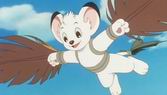
Manga genius Osamu Tezuka’s Kimba the White Lion, a.k.a. Jungle Emperor Leo, was arguably the greatest kids’ cartoon show of all time. How many other Saturday Morning cartoons featured a messianic, super-intelligent white lion cub alongside allusions to Buddhism, environmental issues, Third World politics, genetic experiments, ancient tectonic plates and “super-continents” - several decades before such themes were tackled in grownup television shows? Sadly, Tezuka’s own superb 1966 animated feature is unavailable on DVD but this 1997 movie by writer-director Yoshio Takeuchi provides a worthy wrap-up for a truly epic saga.
In the heart of a wondrous jungle kingdom the birth of two cubs to the legendary white lion Leo (voiced by Masane Tsukayama) and his mate Lyre (Chieko Baisho) receives a jubilant reception from their parading animal subjects. The discovery of a child’s music box aboard an aeroplane wreck sparks curiosity in boy cub Lune (Mifuyu Hiragi) and his sister Lukio (Hekiru Shiina) about the world of men. Though his father warns not all men can be trusted, young prince Lune optimistically believes humans and animals can someday live in harmony. Elsewhere, in bustling New York City, unscrupulous big game hunter Ham-Egg (Danshi Tatekawa) draws attention when he purchases a piece of “moonlight stone” on the black market, which billionaire scientist Dr. Plus (Yasuo Muramatsu) identifies as either an ancient eco-friendly energy source or a Tolkienesque mystical talisman potentially able to save all mankind.
Good guy scientist Mr. Moustache (Kousei Tomita) and his assistant Lemonade accompany Ham-Egg on safari hoping to tape the source of all moonlight stones on Moon Mountain, but discover their guide is a ruthless bastard once he starts blasting animals away with abandon. His actions ignite a vicious turf war with the animal tribes culminating in a forest fire that separates Lune from his family. Swept out to sea, the lion cub is caught and sold to Sergo’s Grand Circus where - with obvious allusions to Dumbo (1941) - he befriends a wisecracking Brooklyn mouse named Jack and rescues an abused mother elephant. Lune also grows enamoured of Mary (Tomoko Nakajima), a beautiful black trapeze artist and joins her hire-wire act.
Meanwhile, a mysterious plague sweeps through the jungle and a guilt-ridden Mr. Moustache enters into a personal truce with Leo in a bid to save innocent lives. In return for his kindness, Leo guides the scientists along a perilous journey up Moon Mountain.
Takeuchi’s movie features enough notable differences to qualify as a “re-imagining” rather than a concluding chapter. The original Kimba/Leo learned kung fu, became a United Nations ambassador, converted predators to vegetarianism and had adventures alongside a 007 style secret agent. He also learned to speak English and had a knack with sci-fi gadgetry. This film downplays Tezuka’s more outlandish concepts, but retains a certain Buddhist-derived mysticism with communication implied between good guys like Dr. Moustache and the animals. It also retains Tezuka’s charmingly retro art style along with his love of pun names and sudden shifts in tone. Social commentary and sweeping humanitarian themes rub shoulders with comic book super-science, wild theories about evolution and genetics, and Disneyesque whimsy. Long-time fans will note the absence of characters like Boss Rhino or Daniel Baboon, but old favourites like Coco the Parrot (Kaneta Kimotsuki) and Tommy the Gazelle (Naoki Tatsuta) are here as you remember them.
If we’re being picky, Lukio adds nothing and the filmmakers prefer to clearly colour characters good or bad, ignoring Tezuka’s subtle moral shadings. But the utopian ideals woven into the allegorical remain affecting in their messages about cooperation, racism, conservation and pacifism. Although not graphic, the deaths of animals, including several major characters are harrowing. So while the film is ideal family entertainment it probably isn’t something you can leave young kids to watch unsupervised.
The lush animation, crafted with care and detail by Tezuka Productions, is worthy of Disney’s finest. Observe the jungle intro wherein a veritable pageantry of wildlife assembles to herald the birth of Lune and Lukio, reaching a crescendo when an elephant and giraffe raise the cubs up to the sky before the Busby Berkley-esque chorus of animals. It’s a symphony of nature. Lookout for the wonderful Dr. Seuss-styled dream sequence where Lune imagines himself riding a rocket ship and giant robot legs across a candy-coloured fantasyland of flower children, shooting stars and trippy human-animal hybrids. Or the awe-inspiring entrance of the prehistoric mammoth Great Mother in a shower of stars, which recalls the Forest God in Princess Mononoke (1997).
For fans however it is Leo and Dr. Moustache’s ascent up Moon Mountain that proves the most affecting. Takeuchi weaves in a surprise nod to The Treasure of Sierra Madre (1948) and concludes on a jaw-dropping note that makes a more poetic point about the cycle of life, death and rebirth than The Lion King (1994) ever did. Be prepared to shed a tear, Kimba fans because a little piece of your childhood goes with him.