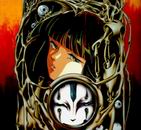
A cloaked vampire is behind a spate of attacks upon young women in Kyoto. Meanwhile, stylish “medium” Himiko (voiced by Mami Koyama) is summoned when a little girl grows comatose with a suspected case of demonic possession. Himiko survives her brush with the bloodsucking fiend who is vanquished by Miyu (Naoko Watanabe), an enigmatic vampire schoolgirl able to walk in daylight and upon whom, crucifixes and holy water have no effect, and her Noh-masked servant Larva (Kaneto Shiozawa). Ancient and all-powerful, Miyu is Earth’s only protector from the Shinma, a race of “demon-gods” from another dimension. Though she survives on human blood, she claims her bite bestows immortality and comfort on those seeking escape from a life of pain. Over a several encounters, Himiko witnesses the vampire princess battle a hideous giant worm, a creepy ghost girl with a doll fixation, and a handsome devil god called Pazuzu, whose past intersects with Miyu’s own.
This four part anime serial was adapted from the manga by creator, character designer, animation director Narumi Kakinouchi, in collaboration with her husband Toshihiro Hirano, one of the true maestros of horror anime. Unlike more notorious genre fare such as Wicked City (1987) or Urotskidoji: Legend of the Overfiend (1987), this forgoes the usual tentacle rape and ectoplasmic ejaculations for subtle chills, intriguing twists and an elegantly eerie atmosphere that gets under your skin. There are Lovecraftian overtones in the demon-gods waiting to reclaim the Earth that bring shades of Hirano’s masterpiece Iczer-One (1985) and its sequels, while supernatural battles rendered via flowing silks and exploding flowers recall A Chinese Ghost Story (1987), but this is essentially a shojo (“girls manga”) horror.
In Japan the foremost consumers of manga are adolescent girls and horror is especially popular. Hence the stories adopt a romantic, psychologically driven approach that involve offbeat twists like the child who loses her mind because she is kept alive by blood transfusions from her dying parents, or the pretty-boy victim that actually wants to be consumed by the female monster (which becomes a twisted love triangle when Miyu vies for his immortal soul). Interwoven is a bleak and haunting reoccurring theme wherein people withdraw into fantasy worlds when reality proves unbearable, and where Miyu challenges Himiko’s preconceptions about good and evil. Critics have taken issue with liberties taken with traditional vampire lore and the fact that Miyu sometimes seems no different to the monsters she’s hunting, but such ambiguity works in its favour.
Kakinouchi’s delicate character designs have an almost tactile quality, from the writhing, seeping, slithering monsters to the silkily sensual heroine. Golden eyed and silkily sensual, Miyu is an alluring, yet unfathomable protagonist whose sense of style must prove a plus point to the target audience. As does the fact she has her own handsome boy-toy under lock and key. Hirano works his magic via some unsettling set-pieces (e.g. crimson netherworlds where giant eyeballs hang from haunted trees; milky-skinned phantoms; scary haired ghost girls that hark back to Kwaidan (1964)), most notably the doll episode that unfolds in the stilted style of a traditional puppet play, complete with weird chanting and percussion effects that add to the creepy mood. The team reunited for a 1997 television series that added a host of supporting characters including little bat-winged rabbit Shina, and for a follow-up Vampire Princess Yui (2001), that concerns a girl whose mother was bitten by Miyu while pregnant.