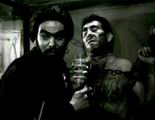
Who is this? Why, it's Coffin Joe (José Mojica Marins) here to ask us, as is his wont, about the big questions in life such as who are you? Who is he? And who really cares? What is the meaning of existence? More importantly to Joe, what is the meaning of fear? In the three stories to follow, our host will investigate this last by taking us on a journey into the macabre, beginning with a tale of an elderly dollmaker (Vany Miller) whose speciality was the life-like eyes of his creations. He worked with his four daughters on these prized objects, but the money they accrued did not go unnoticed...
Actually it takes the best part of ten minutes for that tale to get started, as most of that time is taken up with either Coffin Joe pontificating, and oh how he loved to do that, accompanied by thunderstorms and rolling cloudscapes, or the opening credits which drag on for ages. At least the practice of mentioning everyone who worked on the film whatever their capacity offers us the opportunity to hear the Coffin Joe song, which bears a curious resemblance to the Mickey Mouse Club theme if Mickey had been a morbid evildoer.
Once that's out the way, the chills can begin in earnest, and the first plotline is like an E.C. Comic come to life, or it would be if E.C. had been Brazilian and had opted to include rape as part of their narratives. You can see where it is headed the second the dollmaker's products are complimented on the realism of their eyes, so when a gang of four criminals introduce themselves into the old man's home and start asking for his money their comeuppance we understand is mere minutes away. In a move that would have been unlikely to have been part of a British Amicus portmanteau horror, the bad guys rape the daughters only to have the tables turned on them.
So at least Marins, here co-writing as well as directing, knew that morality was a big part of the appeal of these things, as well as justice of a sort. His Coffin Joe character, who had become a sensation among Brazilian filmgoers, only appeared at the beginning of this and even then his features were obscured, but the same kind of lurid mentality pervaded The Strange World, or O Estranho Mundo de Zé do Caixão as it was originally known. So what to make of the middle entry, where a hunchbacked balloon seller pines for a rich girl who is murdered on her wedding day and finds that he can finally be with the woman he loves in death, as life would have kept them apart?
If anything it shows Marins' sympathy with the outsider, but taken to an extreme where necrophilia is excused if romance can find a way to succeed, however twisted. But he really goes for it in the final segment, where a strangely familiar television panel show guest, supposedly an intellectual (Marins' fans numbered quite a few such members of Brazil's society), holds forth on his theories about love being nonexistent. To prove himself right and the guest who holds the opposing view wrong, he invites the man and his wife over for dinner, but what it actually turns out to be is torture, disfigurement and forced imprisonment, along with a spot of cannibalism for good measure. That intellectual is of course Marins: we recognise his long fingernails, but whether he is Joe in guise is unclear. It all ends with a quote from the Bible to inform us that God is perfectly justified in bringing about Armageddon, and provides shoddy but admirably nutty diversion. Music by Marins and Herminio Giménez.