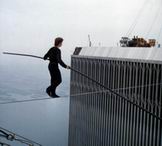
One August day in 1974, a crime was to be committed by an international group of people who might have been unimpressed to hear themselves described as criminals. They weren't out to steal or injure, they were dead set on pulling off one of the most audacious stunts of the decade, and at the heart of it was a little Frenchman called Philippe Petit, a tightrope walker and acrobat who ever since he had seen the news story about the construction of the World Trade Center in New York City, had been struck by a compulsion. Which was to get to the top of those twin towers, sling a cable between them and walk hundreds of feet in the air...
One of the highlights of the 2009 Academy Awards ceremony was when this film won the Best Documentary Feature Oscar, because when, for example, Sean Penn won his trophy for Milk, he didn't balance it on his nose for the benefit of the crowd as Petit did when he joined the filmmakers onstage to accept their prize. But that sums up the irrepressible nature that director James Marsh, probably best known till that time for his macabre dramatisation Wisconsin Death Trip, captured here: Petit's liveliness, his lust for life, his drive to take on challenges he fully admits were "impossible", puts most of the rest of us to shame.
Of course, most of the rest of us would be more sensible than to put our lives on the line for the sense of achievement it might offer, but being sensible was not part of Petit's vocabulary. He tells us that ever since he was a child he had the urge to climb things, and that never left him as we see footage of his first headline-grabbing stunt when he walked between the towers of Notre Dame cathedral. It made his name in his native France, but he had bigger fish to fry. Soon he was off to Sydney and the Harbour Bridge, on top of which he set up a cable and stopped traffic by tightrope walking - and dancing - for a while.
You do not carry off activities such as these without help, and Marsh assembled his team to interview, from Petit's girlfriend at the time to his best friend, all of whom fill us in on details of the daredevil's greatest exploit. Just as in the heist movies that Petit would become addicted to on television, the operation was planned with military precision, all of the participants fully aware that there were many levels of officials who would prevent them ascending the levels of the Center. Luckily for Marsh, the team took plenty of photographs and shot film of their preparations, and the more you see the more anxious you become, especially if you've ever stood on top of a tall building and been scared to look down.
Petit, however, was apparently born without fear, and Man on Wire proves that you don't have to dress up your documentary with whistles and bells when the subject matter is so fascinating. There's little doubt that Petit is the star of the show, barely able to keep to his seat when he describes his experiences, but the quieter interviewees, as observers relating what they witnessed, are equally important. Once we reach the stage where Petit is on that wire between the Twin Towers, the story has become utterly captivating, and even though it is illiustrated with hair-raising photographs and not film, you feel the awesome danger and flair of such a feat. Oddly, by the end it has become unexpectedly moving, not least because nobody will ever be able to try the stunt again, for obvious reasons that remain unspoken here, but also for the personal effect it had on those involved.