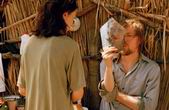
Nobody seems to know why he is now financially independent, but Mikhail (Félix Lajkó) has returned home to his isolated home village on a delta on the River Danube. His mother (Lili Monori) is pleased to see him at least, and the sight which greets him when he arrives back at her house - a pig being slaughtered for the dinner table - is lightened when his mother welcomes him and orders his sister Fauna (Orsolya Tóth) to embrace him as a hello. Mikhail has plans to settle in the area after his time away, and now begins work on his house, which he wishes to build himself. But Fauna is eager to help...
When Bela Tarr is invoked in the opening credits to Delta, it should give you some idea of what to expect: lyrical, austere and Eastern European misery all the way. This film almost remained uncompleted when the leading man died, but director Kornél Mundruczó persevered, recast the main role and managed to finish it. Granted, the reviews were mixed at best, but it was an achievement to have it released after the hardship in its production, and if nothing else all were agreed that the Hungarian landscape - and riverscape, if there is such a word - stood out as something worth watching for the ninety minute duration.
Really it's the choice of locations and the beautiful style in which they were photographed by Mátyás Eldély that provides the strongest reason to view this, as the plotline is a muted examination of the justification of Old Testament justice meted out when Mikhail and Fauna fall in love, and much to the horror of the villagers, do nothing to prevent taking their relationship further. The film leaves the judgement either up to those locals or to you, the viewer, but the thought of the permanently squinting from under his hair Mikhail and the whip-thin Fauna getting it on together wouldn't exactly be an enticing one even if they were unrelated.
This is not meant to raise passions, or if it is it doesn't do a very good job of it, as too many scenes of silent contemplation put paid to any excitement, sexual or otherwise. Such sequences have their own power, as when a group of river folk travel down the water while apparently accompanied by a male voice choir on the soundtrack, but just as easily veer towards unintentional self-parody, taking an unsavoury subject like incest and treating it to the shoulder-bowing weight of art film mannerisms. Not that Delta will have you chortling, the imagery is too tranquil for that, but it does come across as taking what most people will regard with an "ew" to replace that reaction with an "Oh..."
There's more than a touch of the Straw Dogs about this film, with its insular locals not liking the outsider Mikhail has become in his time away, and assembling at the end to dole out their retribution for the breaking of God's laws - not only God's laws, either, unless the courts have a different view of incest in Hungary, which I doubt. There's even a rape scene when Fauna is assaulted by her mother's boyfriend after she tells him she is off to live with her brother, although it's filmed from about a mile away lest anybody be wanting some ill-advised thrill from it. Thrills, of the distasteful kind or whatever others could be mined here, are not what this is about, as it's more of a sober reflection on how far you go to forgive or reject the sinners. You don't get the impression that Mundruczó is on the villagers' side, put it that way. It was the tortoise I was worried about. Music by Lajkó.