Set in the 19th century, this intriguing Russian gothic thriller concerns Bielarecki (Boris Plotnikov), a young ethnographer who seeks refuge at Marsh Firs, an isolated castle in the Northwest marshlands, while he conducts research into the myths and legends of the region. The castle’s young and tragic owner, Nadzieja Jankowska (Yelena Dimotrova) claims her estate is haunted by two ghosts - the Little Man of Marsh Firs and the Lady in Blue - and that her family is cursed. Centuries ago, her ancestor Roman Jankowska denied the hand of his daughter to King Stach, whose vengeful ghost now rides with his thirteen horseman to drag Jankowska offspring to a watery death in the surrounding marshes. As the voice of reason, Bielarecki suspects a conspiracy at work and investigates the eccentric characters that populate the castle. But Nadzieja maintains she has met Bielarecki before, causing him to wonder if he might be one of the castle ghosts himself.
Barely known in the west until very recently, The Savage Hunt of King Stach is compelling and atmospheric mystical mystery with plot elements that strike parallels with the likes of Don’t Look Now (1973), The Hound of the Baskervilles (1959), Lisa and the Devil (1973) and even Tombs of the Blind Dead (1971). Adapting a novel by Vladimir Korotkovich, writer-director Valery Rubinchik preferred to think of this as a realistic drama with vaguely mystical overtones rather than a full-blown horror film. Yet although the slow pace won’t be to everyone’s taste, there are enough thrills, chills and moments of spine-tingling magic to qualify this as a classic scary movie of the 1970s.
Rather like Luchino Visconti adapting an M.R. James ghost story, the film holds us spellbound in its depiction of an steadily decaying aristocracy clinging to courtly rituals and superstition. True to the Soviet era, these noblemen and women are ashen faced, subservient to archaic rules and haunted by the spectres of past sins, while parallels are drawn with the suffering of Russian peasantry under the Cossacks, as embodied in Belerecki’s encounter with a group of children driven from their homes by the savage hunt. It’s a film of dreamily unsettling images, from the cobwebbed castle with its baroque décor and semi-flooded interiors festooned with dollhouses, to those misty moors.
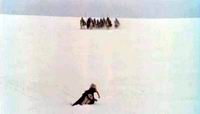
Rubinchik gets further under our skin with his inspired use of sound effects (e.g. the sound of galloping horses while the Doctor recounts the legend of King Stach), while Yevgeny Glebov’s soundtrack equally conveys the unsettling and oppressive mood, combining weird electronica with orchestral flourishes and shivery lullabies. Away from the subtle chills, Rubinchik is not above staging a good, old fashioned scary moment and the sight of King Stach’s horseman thundering across the frozen wastes is pretty darn terrifying. The haunted, almost birdlike performances of the cast almost disguise the slyly humorous script, peppered with quips like “Things are resolved easily and logically only in bad novels”, or the police captain who observes there is “something rotten in the state of Denmark.”
At one point a character observes: “Barbarity in people’s souls breeds fear, gloom, madness and death”. Bielarecki seems to herald the arrival of a more rational age and it is presumably no coincidence the mystery is resolved on the first day of the twentieth century. And yet, although the hero galvanises the peasants to fight back in a mass of flaming torches and the scheming villains are unmasked in classic Scooby-Doo fashion, it’s not all happy endings. Revolution is on its way as symbolised when Bielarecki casts a farewell glance upon the forelorn children, who a decade later will presumably grow up to overthrow the Tsar.