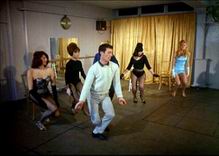
This is London, home to nine million people, most of whom would not consider themselves to be on the level of animals, yet this documentary is here to tell us there is a strong comparison between the behaviour and incident that the natural world experiences and the one which the human world goes through. After all, everyone is born and everyone dies, and we see a new arrival being given birth to who is already suffering as the baby fights to draw breath. Along the way, we wlll witness the likely journey he will have should he survive, from school to work to all the trappings of life in the big smoke...
Arnold L. Miller, the director of Primitive London had tried this sort of thing before with West End Jungle and London in the Raw, but his main influence here was obviously the Italian mondo movies, pseudo-documentaries that concentrated on the more sensational material that they could find - or invent. The theme of this is that underneath the veneer of civilisation which London had as its image in the sixties, there was a turmoil of baser emotions which bubbled up to the surface in the fashion we are treated to here, whether they be strip clubs (and lots of them) or the hidden truth behind what we take for granted.
That hidden truth can take the form of watching how chickens are prepared for the supermarket, complete with the narrator (David Gell) informing us that the housewife is a form of predator for buying the chickens for her family, and presenting this as a hypocrisy as she does not care how degrading and vile the situation the battery farmed birds have been put through as long as she gets to put food on the table. Not much has changed in that case, perhaps, but as usual with this kind of thing the mock outrage is pretty hard to believe in light of the way the clips are served up for entertainment.
You get the impression that Miller and his producer Stanley A. Long, a regular in this type of effort, had to struggle to find anything truly shocking to justify their X certificate. Indeed, they had to include a sequence about Jack the Ripper simply to be awarded one, and it sticks out because it's a recreation of a crime that took place nearly a hundred years before, and not a very good one at that. You feel that the filmmakers are happy telling you of a more recent slayer: the motor car, which boasts thousands more deaths than some Victorian serial killer. Really, this is about how modern they could be with their observations (not to mention their bizarre bickering interrupting the soundtrack - assuming it was them and not stand-ins).
Naturally, it all looks, well, primitive compared to our standards now, but that can be part of its charm. At least it never drags, picking and choosing its subjects liberally to ensure the audience didn't tune out from this parade, and even for this sort of thing the tone was not as sanctimonious as it could easily have been. They were awfully keen on bringing those strippers to the screen, though, even if they don't end up completely naked, but get down to the barest minimum instead. The presence of celebrities adds a little sparkle, as Billy J. Kramer is mobbed by fans at a record shop while yesterday's idol Terry Dene looks on wryly, and famed wrestler Mick McManus is shown rehearsing a bout. You can also spot an uncredited Barry Cryer appearing in a comedy set up to do with the advertising scene. While it now looks tame, historically Primitive London is full of interest, if only to see what was regarded as shocking in the mid-sixties, from its key parties to the new insult comedians. Music by Johnny Coleman and Basil Kirchin.
[The BFI's DVD has a wealth of extras, from interviews of the time to a vintage featurette about stripping, and a special booklet detailing the background to the film.]