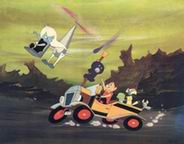
Joyriding through the woods with his animal friends, plucky young Jack (voiced by Meiko Nakamura) meets Kiki, a white-haired girl flying a mini-helicopter. The naughty minx lures the gang to Devil’s Castle, where Grendel the witch hatches a mad scheme to transform kids into monsters using her Devilization Machine. Jack’s pal Chuko the mouse is turned into an evil imp, but our hero and friends Barnaby Bear, Phileas Fox, and a curiously nameless wee doggy with blonde pigtails (?) fight their way through demons, dinosaurs and man-eating mushrooms. When Kiki falls from the sky, Jack nurses her back to health. But can she be trusted to help them sneak inside Devil’s Castle and save the world?
One of the great Toei fairytales, Jack and the Witch is a candy-coloured riot of imagination. Commissioned to mark their anime division’s tenth anniversary, this is not - as some sourcebooks have claimed - another version of Jack and the Beanstalk (1974), but actually a surreal updating of Beowulf. Pioneering anime auteur Taiji Yabushita made many of Toei’s early classics, including Panda and the Magic Serpent (1958), Magic Boy (1959), Alakazam the Great (1960), and The Littlest Warrior (1961), often collaborating with young animators like Yasuji Mori, Osamu Tezuka, Yugo Serikawa and Isao Takahata who went on to glittering careers within the industry.
Yabushita’s artistry is apparent right from the opening frames. Credits done in the style of medieval stained glass windows recount the legend of Saint George and the Dragon, equating the wild and wacky plot that follows with primal, age-old myths. Thereafter the film springs from one daring visual experiment to another, reaching a trippy highlight when Jack and friends are trapped inside a garden of giant flowers. It rivals the “Pink Elephants” sequence in Dumbo (1941) for sheer verve and freaky ingenuity, as the gang leap into psychedelic flower-worlds, face colourful clouds of man-eating pollen, warrior mushrooms and carnivorous bugs who plot their doom (“Let’s have them deep fried in lots and lots of butter”).
The plot concocted by scriptwriters Shinichi Sekizawa - a dab hand at juvenile fare from Mothra (1961) to Godzilla vs. the Sea Monster (1966) and Gulliver’s Space Travels: Beyond the Moon (1965) - and Susumu Takahisa has a “make it up as you go” quality, but unfolds like an irrational childhood nightmare. From the moment our heroes cross into the “witch world”, the hyper-manic hysteria proves powerful. Yabushita and his animators cram in an incredible amount of detail, from the gothic hallways and art deco furnishings of Devil’s Castle, to surreal imaginings like the moment Kiki sees the witch’s floating head transform into a dinosaur skeleton that melts into an ice cave full of frozen prisoners.
Reiji Koyama’s character designs have that eccentric sense of style lacking in much contemporary anime. From the pitchfork-wielding devils to the animal heroes, each of the characters have individualistic traits to match their personalities. Phileas Fox sports a snazzy blue cravat. The little dog has her oddly chic blonde hairdo. Woven into the hair-raising action (Kiki airlifts Jack’s house across the sky), sing-along musical numbers (Seiichiro Uno wrote the first award-winning anime score), and outbreaks of sheer weirdness (a climactic plunge into a spooky netherworld of candy-coloured lava, armies of lava dinosaurs and funky phantoms) is a message about displaying kindness and compassion even to your worst enemies.