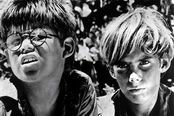
Great Britain is under threat as a new World War has started, this time using nuclear weapons, so with the country dangerous to live in, children are being evacuated from it. One aeroplane carrying about thirty public schoolboys gets caught in a storm and crashes onto the beach of an uninhabited island, leaving them stranded. Ralph (James Aubrey) first meets a fat kid (Hugh Edwards) as they make their way through the jungle, and he tells Ralph not to call him Piggy, which is what they used to call him at school, so naturally that is what he is named by the rest of the survivors. Then it dawns on them - nobody knows where they are...
The theme of William Golding's most celebrated novel Lord of the Flies has become so well known that it threatens to turn into a cliché: the group of people stranded who revert to savagery no matter how civilised they thought they were in the first place, here made all the more shocking by the notion that the survivors are children; we can see its influences everywhere from Dennis Potter's Blue Remembered Hills to the television series Lost, such is the potency of the ideas it brings up. It's a bleak view of human nature for sure, and one which was brought to the big screen in theatre director Peter Brook's film.
Shot in stark black and white rather than lush colour that could make the island look like some kind of paradise on Earth, Brook appears to have been aiming for a documentary look to his story, though while the young actors were improvising their roles, they do stick pretty closely to the events in the original novel in the final edit. Ralph is elected leader by a vote, as the children ape the absent grown ups, but soon his chief rival Jack (Tom Chapin), head of the choir who make a surreal entrance dressed in their uniforms and singing along the beach, has the upper hand as it is he who sets out with his choirboys to hunt.
Perhaps more than the fear that we are one simple disaster away from outright brutality, Brook brings out the dread that the barbarians are about to take over, and worse, it will take one strong force for primitivism to bring down civilisation in one fell swoop. Ralph is the voice of reason, making sure that there is a fire so any rescue party can be made aware of the boys' location, but Jack is his opposite number, whipping up his followers into a frenzy of pig-hunting and not caring whether there is a fire lit or not as after all, he is the king of this particular castle now that he can guide his mob into bullying the others into following him.
It is the weak who suffer, embodied by Piggy (we never find out his real name) who has his useful aspects, that is the fact that his glasses can concentrate the sun's rays to make fire, divorced from his character, so that first he is a figure of fun and then most of the others grow to despise him for his lack of vigour: he cannot hunt as he suffers from asthma. Just as the worst elements of society are magnified on this island, from baseless superstition to outright prejudice, we are supposed to draw our conclusions that we are on the brink of catastrophe, although with the plot so well telegraphed even if you don't know the book you will be able to foresee how this will play out. In the end, this Lord of the Flies is either too hysterical or not hysterical enough as it translates a little too artificially whichever way you look at it, but is an admirable attempt, and certainly miles better than the nineties version. Music by Raymond Leppard.