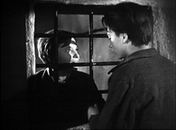
Pasquale (Franco Interlenghi) and Giuseppe (Rinaldo Smordoni) are best friends in Rome, just after the war where poverty is rife and the American soldiers are still on the streets. At least the presence of the U.S. troops offers a cash flow for the boys, as they make their money by shining their shoes, all with the notion of saving up to buy their horse. They have their eye on a stallion who is kept by a stable owner just outside the city, and it looks as if they will be saving for a while as Giuseppe's mother always wants a cut of their profits. Then an opportunity arises...
Vittorio De Sica had directed films before Shoeshine (in Italy, Sciuscià, an approximation of the word shoeshine), but they had not enjoyed the impact of this one which went on to international acclaim and even a special Oscar, possibly because those audiences lavishing praise on it were made to feel deeply guilty and wished to make up for this somehow. Certainly De Sica didn't pull any punches about his depiction of the misery of the poor and how hard it hit the most innocent and undeserving members of society, and if you go into this expecting a happy ending then needless to say you're being overly optimistic.
The Itailan Neo-Realist movement of which this was at the forefront was realistic as much by necessity as it was by design, as the studios were struggling due to the recent war in Europe, so that trademark location filming was somewhat forced upon anyone wishing to shoot their stories. At the time, it was startling and vivid, though to our more jaded eyes the effect has lessened to a degree, but the sincerity of Shoeshine will never diminish, as this is a deeply felt indictment of a society that allows such injustices to flourish.
The way this film sees it, even the simple wish of these two friends can be corrupted, their untarnished joy of riding their horse ruined by people who are happy to let them suffer. These include the authorities, who pick up the boys after they ill-advisedly get involved with black market goods, although it's made clear they were too naive to know what they were getting into, and those criminals who use children to make money for their illegal buying and selling. Therefore the next step for Giuseppe and Pasquale is prison, where they join others like them and receive an education in lawbreaking they would not have done if on the outside.
Still, their spirits are allowed moments when they can rise, but increasingly rarely as they grow more hardbitten after the knocks that life hits them with. Put in different cells, they miss each other desperately - the boys' friendship is just about the only thing in this film that is portrayed as beneficial, making it all the more heartbreaking when even that is taken away from them. This is because the prison governors fool Pasquale into thinking Giuseppe is being beaten savagely the longer he refuses to talk and incriminate those who were involved with the black market. So Pasquale grasses, though not on the real masterminds behind the racketeering, and the friendship suffers. Although Shoeshine was unbearably moving in its day, now you can see where De Sica and his writers are pulling the strings, and the manipulation does look a little contrived, especially in the way the drama resolves itself. Yet his sad-eyed indignation still rings true, and alas has not become any less relevant. Music by Alessandro Cicoginini.