Teenage Hungarian Eva (Eszter Balint) gets off the plane in New York and makes her way through the streets to the dingy apartment of her cousin Willie (John Lurie), a man who has been assimilated into American culture far more successfully than, say, his Aunt Lottie (Cecillia Stark) who has telephoned him to inform him of Eva's imminent arrival. He is none too pleased, but does not have much choice in the matter as the girl has nowhere else to go. When she turns up, he is aggravated with her, but she isn't exactly delighted either, although over the ten days that she stays with him they reach an understanding...
After Permanent Vacation made small ripples on the big pond of indie cinema, Jim Jarmusch found himself with some film left over from a Wim Wenders movie shoot with which to make any story he cared to. Starting out as a short work then expanded into what we see today, Stranger Than Paradise found a following of movie fans unexpectedly engaged by these inarticulate, going nowhere characters, and the cult of Jarmusch was well and truly underway, with his trademark deadpan humour, deceptive lack of incident and rambling plotlines.
If anything this was the opposite of an action movie, an inaction movie if you will, so in place of car chases, explosions and fistfights there were mumbled conversations, frustration, lethargy and although there is a car, it doesn't get into any high speed pursuits even if it does travel a long way. On first glance, there seems precious little to entertain all but the most dedicated viewer, but the more you watch it, the more you are immersed in this muted world and after a while you are, like these people, pondering what kind of animal is in a T.V. dinner.
The narrative is split into three parts, all filmed in exactly the same style, which is to set up the camera in a corner of the scene, allow the actors to make their way through the dialogue (which sounds improvised), and then cut to black for a few seconds. Repeat until the experience is over. You may think that a film where nothing much physical occurs might be hamstrung by the fact that the characters struggle to think of anything to say to each other, yet in effect this becomes the biggest joke, culminating in a cruel but wincingly amusing punchline right at the end, proving that if they had sorted out their communication problems, their malaise might have been solved.
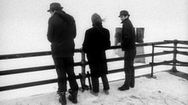
The first part takes place in New York City, looking mightily inhospitable, as Willie and Eva get to know each other and Willie's best friend Eddie (Richard Edson), also goodnatured but reticent to engage in useful conversation. They spend their time watching television in the cramped apartment, with Willie exasperated initially, but eventually buying a dress for his guest, which she is so delighted with that she drops it in the trash outside after bidding him farewell to go to Aunt Lottie in Cleveland. One year later, in part two, Willie and Eddie are looking for adventure so head out on the highway to, er, Cleveland in the depths of winter for more unfulfilling times with Eva, then in the last part all three of them decide life would be better if they went to Florida, which you can guess fails to satisfy them. A film about the illusion of movement and progress, where you can travel hundreds of miles to find out you might as well have stayed where you were for all the good it has done you. Music by Lurie.