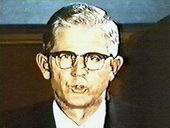
This is the Reverend Estus W. Pirkle, a preacher from the South who has a message of hope for the world, a message of salvation through the power of Jesus Christ. He avers that everything he says in this film is based on fact, because it is common knowledge that Communism is poised to dominate the world completely: it already does in the Soviet Union, China and other parts of the globe, so it's only a matter of time before the United States of America is under attack. Within twelve months, says Pirkle, if nothing is done to stop the moral decline in his country the Communists will have taken over.
That's within twelve months from the release date of this film, 1971, and if you check your history books you'll see that the Reverend Pirkle's awful warning didn't exactly come to pass: actually nothing like it happened at all. Out of all the films made by exploitation director Ron Ormond, this is probably the most singled out for cult attention, and it happened to have been made after his conversion to born again Christianity, so you know he believed every word his religious friend here was saying. Ormond spent the last decade of his life putting out pious films like these, but something in his background could not be shaken off.
Thus these works, which lest we forget were largely shown in churches to congregations of Godfearing folks who could probably have well done without this kind of assault on the senses on a Sunday, took on the lurid appearance of Ormond's previous efforts when he was simply out to make a fast buck from the Southern drive-in circuit. To call If Footmen Tire You, What Will Horses Do? over-emphatic is to understate quite the level of scaremongering being implemented here - whatever happened to all that peace and love business that Christianity is supposed to be based on? Here it's more like a blatant threat to accept Christ into your life or suffer horrible consequences.
Although the film takes the form of a lecture, in effect the sermon as told to a few rows of doughy-looking, blank-faced parishioners, there is a story of sorts. There are two, really, the first concerning what will happen when the Communists take over, some with American drawls and others with comedy Russian accents, but all with the express wish to gun down as many Christians as possible. Honestly, there must be at least five minutes of footage of extras lying on the ground covered in fake blood interspersed with the sermon, to the point that Ormond seems to be fetishising the possibility of massacres caused by these invaders, especially when you see what happens later on.
This kind of violence will happen because America has been set on the road to damnation by such horrors as young people, drugs, alcohol, dancing, miniskirts and Saturday morning cartoons; Pirkle points out that with television so prevalent, people now have a choice for something to do with thier lives other than read the Bible. As if all this intolerant hate-spewing wasn't weird enough, look at what the Communists will do as Ormond turns this into a gore movie: pushing sharpened sicks through a little boy's ears so he cannot hear the word of God (he vomits), forcing a Christian man's children to impale him on upturned pitchforks and chopping off another little boy's head (won't somebody think of the children!) for refusing to stomp on a painting of Jesus. The other story here is of the salvation of Judy (Judy Creech), a bad girl in the congregation who sees the light, but in her big scene, there's a middle-aged woman quite plainly asleep behind her on the pews. By turns hilarious and offensive, it's hysterical pontificating like this which gave Christianity a bad name; Pirkle seductively whispering, "Will you come?" does stick queasily in the mind.