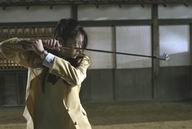
At midnight, snow falls gently on a quiet Japanese town. Suddenly, a breathless schoolgirl races by, pursued by a hulking, hooded phantom with a roaring chainsaw. Hapless slacker teen Yosuke Yamamoto (Hayato Ichihara) is poised to intervene when the girl, Eri (Megumi Seki) whips out a set of blades and a samurai sword and kicks the monster’s butt into outer space. This chance encounter turns Yosuke’s life around. An apathetic youngster, dozing his way through school, he mourns the death of his cooler best friend Noto (Harumi Miura) whilst committing petty theft, riding his bike at night and generally slacking off. Mourning a tragic loss of her own, the mysteriously superhuman Eri returns to battle the chainsaw monster every night when it literally falls from the sky.
Now Yosuke joins the fight, hoping to ease their pain and somehow make the world a better place. Between battles they bicker, bond and begin to fall in love, but then Yosuke’s parents ask him to move to a school in faraway Sapporo…
Ever wondered what Gregory’s Girl (1980) would be like if fused with Ingmar Bergman and The Texas Chain Saw Massacre (1973)? No, neither have I, but that is the closest comparison to watching this seriously offbeat teen-horror-rom-com. Based on a popular novel, this weaves a sweet natured love story, horror movie imagery and slapstick comedy into an absurdist, existentialist parable about teen alienation. The fight choreography, while bloodless is acrobatic and amazing, although not really the point. At its core this is a story that ponders why Japanese youth lost their “get up and go” spirit and muses why life is worth living when horrible things happen arbitrarily to friends and family.
“You kids are clever”, observes Yosuke’s teacher. “You saw nothing could ever change and gave up trying.” This post-modern malaise afflicts Yosuke, who idolizes his dead friend Noto, himself an alienated youth who gets into fights and an eventually fatal accident just to feel some kind of emotion. Elsewhere, his other friend Watanabe (Yosuke Asari), struggles to finish composing a song and prove this isn’t just another failed project like his attempts at painting and photography. For Yosuke and Eri, who perceives the chainsaw monster as a Bergmanesque personification of death and despair, monster-slaying becomes another kind of extracurricular activity, one that opens their eyes to a more meaningful way of life.
The film occasionally drags between episodes and the whole tough girl-nerdy guy combo has fast become a cliché in Asian popular culture, but there are laugh out loud gags (e.g. a Sergio Leone-styled face off between two rowdy street punks that ends with both saying sorry), touching moments and plenty of visual flourishes from director Takuji Kitamura. These include a camera zoom inside the hellish mechanics of the chainsaw, wire-assisted airborne action amidst a brightly lit fairground or around a stadium sized swimming pool, and a lively musical montage set to Watanabe’s pop “masterpiece.” Megumi Seki and Hayata Ichihara make an engaging screen couple, although the former isn’t as forthright as the delightful Rika Ishikawa (wasted in a comedy cameo as a leggy, hot-tempered landlady) might have been in the lead role.