Ten year old Chihiro (voiced by Rumi Hiragi) moves to the countryside where her mother (Yasuko Sawaguchi) and father (Takashi Naito) stumble across a deserted town which they mistake for an old amusement park. Stuffing themselves with huge platefuls of delicious food, the parents transform into hideous pigs as Chihiro is horrified to discover they have trespassed into an enchanted world of monsters, spirits and vast animal gods. Help comes in the form of Haku (Miyu Irino), a mysterious boy with magical powers, who advises her to seek employment with the wicked witch Yubaba (Mari Natsuki).
Under the new name of Sen, our young heroine works at a hot springs resort for gods and monsters, enduring hardship and adversity with resilience and pluck. She makes friends with spider-limbed engineer Kamaji (yakuza film icon Bunta Sugawara) and feisty servant girl Rin (Yumi Tamai), but attracts unwanted attention from the creepy, shadowy No Face. Meanwhile, Yubaba is waging a secret feud against her twin sister, Zeniba and Chihiro finds herself in the firing line when she discovers the witch’s grotesquely oversized infant and a surprise secret about her friend, Haku. A secret that could set them both free.
Spirited Away was the movie that belatedly broke anime genius Hayao Miyazaki into the English-language market, winning the Academy Award for Best Animated Film and becoming the highest-grossing Japanese movie of all time. It is truly a masterpiece, one of the greatest anime movies ever made, but in the rush to embrace Miyazaki into the mainstream, many critics, who unfairly lambasted his earlier work, lost sight of the subtleties and nuances in this remarkable movie.
To paraphrase one example, the film’s core theme has been described in the Radio Times Film Guide as “a bratty girl learns the value of being true to yourself.” Which sounds like the kind of vague, self-actualizing gobbledegook you’d find in a 1990s Hollywood cartoon. The hint being, Miyazaki found mainstream success by outgrowing his “eccentricities” and simply embracing conventional, family entertainment. Well, Spirited Away is a great family movie, but by no means is it simple or conventional. In fact it’s downright subversive.
Miyazaki’s blockbuster hit theatres when Japan was in the midst of its first major economic slump (ne plus ca change, huh?). Homeless people were sleeping in the streets, hitherto unheard of in Japan, while news that ordinary, middle-class schoolgirls were prostituting themselves caused a major scandal. Indeed, many of the cinemas screening Spirited Away were but a stone’s throw from the strip clubs and sex parlours where such young girls worked, which suggests Studio Ghibli’s marketing plan had artistic ingenuity to match their film’s content. Always foremost concerned with the plight of young people, Miyazaki was also inspired by his friendship with the little daughter of a Ghibli staff member. He intended to make a film for her generation just as Princess Mononoke (1997) had been aimed at their older brothers and sisters.
Far from bratty, Chihiro/Sen is sensible and conscientious, albeit in early scenes perhaps more realistically sulky and purposeless than past Ghibli heroines. Her parents are bubble economy gluttons who let their daughter atone for their greed, just as a generation of spendaholics left their kids a legacy of debt and despair. As with past movies like Kiki’s Delivery Service (1989), what Miyazaki strives to create is an environment that nurtures and challenges young people, a world that combines traditional values with a progressive modern outlook.
A modern-day Alice adrift in an ancient wonderland, young Chihiro/Sen’s adventures teach lessons about duty, hard work and good manners, but also allow her to challenge prejudice and social taboos. Many people’s favourite set-piece finds Sen struggling, all alone to cleanse the pollution-clogged “Stink God”. Miyazaki’s familiar environmental concerns are interwoven with some hilarious physical comedy when Sen whiffs that god-awful stench. Yet her steadfast courage and resolve, literally lift our spirits and the River God bursts free all shiny and new.
With characters like Yubaba and her offspring part-inspired by Sir John Tenniel’s famous illustrations for Alice in Wonderland, there is a touch of Lewis Carroll about proceedings. However, Spirited Away is also part of a long tradition of “yokai” (Japanese forest spirit) movies that encompass classic family fare like 100 Monsters (1968), Spook Warfare (1968) and Along with Ghosts (1969) and contemporary remakes including Sakuya - Slayer of Demons (2000) and Takashi Miike’s The Great Yokai War (2005). The party-loving giant monsters are wholly delightful and range from talking frogs and enormous ducks, to floating heads and majestic Asian dragons. My personal favourite is the giant lump who shares an awkward elevator ride with a clearly nervous Chihiro, but the entire steampunk ambience of this lively, boisterous monster land gleefully exhibits Ghibli’s magical skill.
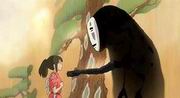
This is also the closest Miyazaki has come to making a horror movie. From a setup straight out of Seventies horror, to Yubaba’s hair-raising rants (the moment she floats Chihiro inside her domain has a spooky elegance worthy of Jean Cocteau), but none so creepy as shadowy phantom No-Face. Many have picked up on the paedophilic undertones, but No Face also embodies materialistic temptation. Greed literally consumes his victims (while he rampages as freakishly as a Rob Bottin creation), but while others debase themselves, Chihiro/Sen refuses his money. It’s not money, but self-reliance that can get her out of the mess she is in.
Just when the plot seems to have settled into a recognisable shape, Miyazaki pulls off a dynamic narrative shift. He has little patience for the cosmic cruelty of horror. Beneath every monster lurks a vulnerable living being and it only takes a little kindness and civility to draw that out. Spirited Away’s latter half finds the three most monstrous characters reborn as a chubby little mouse, a tiny bird and a helpful apprentice. It’s a reoccurring Miyazaki conceit: transforming to experience life in another form, but also fits this film’s childlike subversion of horror movie imagery. In place of splatter we have a cycle of gloopy, gooey of eating, purging and cleansing that leave them transformed for the better.
When Chihiro confronts No-Face, it is as though she were confronting Japan’s warped underbelly, its tortured pop culture psyche. But what she offers this monster is not death but reconciliation. In the past, pop culture commentators heavily criticised Japan’s fetish for cheerful schoolgirl heroines, as the embodiment of bubble economy decadence. Here, a plucky schoolgirl leads monsters back into the light and while the progresses beyond this point to show Chihiro’s spiritual growth, the abiding image remains her flying hand-in-hand with Haku into the clear, blue sky. While other anime auteurs at this time were busy using computer graphics to create eye-popping 3-D robots or spaceships, Miyazaki uses CG in a more sparse and inventive way. Now and then, a run through a field of beautiful flowers or the sudden rising of a cloud takes your eye, but the beautifully fluid, hand-drawn visuals and pastel hues speak eloquently enough. As does Joe Hisaishi’s transcendent score.




 9 (from 4 votes)