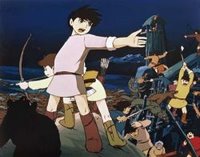
A breakthrough movie for future Studio Ghibli co-founders, director Isao Takahata and writer/character designer/animation director Hayao Miyazaki, who probably made the tea too. Little Norse Prince boasts a higher cel count than any other anime made at Toei in the Sixties, which is apparent right from the first dynamic scene where boy hero Horus (voiced by Hisako Okata) leaps and whirls his axe, fighting off a pack of hungry wolves. The battle rouses towering stone giant Moog (Tadashi Yokouchi), whose gratitude Horus earns by removing the Sword of the Sun wedged inside his shoulder. The magic sword proves handy when Horus’ dying father (Hisashi Yokomori) sends him and his cuddly bear sidekick Coro (Yukari Asai) back to the fishing village they once fled after the demon king Grunwald (Mikijiro Hara) attacked.
Along their way, the scheming Grunwald tries to lure the boy over to the dark side, but Horus escapes and reaches the village in time to slay a marauding monster fish. His heroism earns the friendship of bereaved youngster Flep and chief’s son Potom (both voiced by Junko Hori), but also resentment from the Village Chief (Masao Mishima) and duplicitous Drago (Yasushi Nagata). Later on, Horus rescues the beautiful, bewitched Hilda (Etsuko Ichihara) and her animal friends, friendly squirrel Chiro (Noriko Ohara) and shifty owl Toto (also voiced by Hisashi Yokomori). Her mellifluous singing has a hypnotic effect on the villagers, lulling them into a false sense of security so they stop fortifying their home and listen to her all day. It’s all part of Grunwald’s wicked plan, one that even Horus struggles to stop, when the villagers turn on him.
Far from just another fantasy adventure, Little Norse Prince was intended as a call for revolution, both political and in the animated medium. Miyazaki and Takahata were ardent Marxists, part of a generation of college-educated youth dismayed to see left-wing idealism and Japan’s post-war dream being slowly betrayed. The fifties and sixties saw rampant consumerism on the rise, not to mention Japan playing a key role in America’s war on Asian communism. Just like in the West, it was an era of student unrest, only where their European counterparts looked to live action movies, Cahiers du Cinema and Jean-Luc Godard, Japanese lefties looked to manga: Osamu Tezuka, the Showa 24s, and especially the rebellious ninja boy tales of Sanpei Shirato.
Miyazaki and Takahata wanted Little Norse Prince to be the anime equivalent of Shirato’s Marxist-leaning manga, and also a riposte to the cookie-cutter television shows they felt were dragging the medium down. Thus the film boasts strong scenes of psychological realism (e.g. when Horus kills the monster fish, he is attacked by young Flep, angry he can no longer avenge his father) and bold statements about the difference between “real” art and “false” art as an opium for the masses, alongside moments of real visual panache: an action sequence done in still frame, staccato editing modelled after Sergei Eisenstein, scenes of peasants hammering anvils that resemble Soviet propaganda films.
There are truisms here, like how in the conflicted Hilda, Takahata illustrates how fear drives good people to do bad things, although the core idea that when people stand together they can defeat any monster (be it giant fish, demons or fascism) has precedent in such non-communist works as the westerns of John Ford. Toei’s top brass were breathing down Takahata and Miyazaki’s necks, so this includes all the cuddly animals, Godzilla-style giant monster fights (including Moog vs. a frozen mammoth), and sing-along musical numbers - most involving adorable little Mauni (Yoko Mizugaki) - one expects from a children’s film, but strikes a fine balance between straight drama and cuteness.
What moves most is its makers faith in the inherent goodness of human beings, with every major character contributing something to the final fight. Unfortunately, the film was not a commercial success in Japan, although it was well received in Europe (under the title: The Little Prince Valiant, implying a bogus connection with the famous comic strip) and especially Russia. It would be nine more years before an artistically mature anime became a mainstream hit, by which time Miyazaki and Takahata (demoted to Toei’s television unit in the interim) had notched up a string of hit children’s series and were ready to launch their own studio.