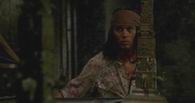
Raphael (Johnny Depp) is a poverty-stricken Native American who lives in a caravan with his Hispanic wife and their young son and daughter. The caravan is part of a shanty town next to a garbage tip full of old car parts that they forage through daily, looking for something to sell for food and Raphael realises that not only does he not wish to live like this any more, but he wants his family's quality of life to be drastically improved as well. The sole way out that he sees is to accept an offer he heard about in a bar: for a fortune in money, he has agreed to be killed for sport in a snuff film.
The Brave was Johnny Depp's directorial feature debut, and as with many of those first films helmed by stars there was a fair measure of the impressionist getting to the end of his act and saying with a flourish, "And this is me!" with the hope that the audience will be just as impressed with the real person behind the performance as they were with the performance itself. Of course, Depp starred in it as well, and as a different race to boot, apparently aiming for the shaky connection between the millionaire movie star and the destitute at the other end of the social scale.
Needless to say the film takes itself very seriously, so seriously in fact that when Depp heard the bad reviews he was getting from American critics he refused to allow it to be shown in his country of origin. Were those critics justified? You can certainly see why it's possible to take against this, with its self-importance, funereal pace and photography that is so crepuscular, even in direct sunlight, that it is at times hard to see what is going on, yet with a story so centred around the inevitability of death, it's pointless to accuse it of not working up an authentic atmosphere of encroaching doom.
Indeed, there are sequences in this which resemble a Harmony Korine effort, as it concentrates on the downbeat and unglamorous side of life; some would say it wallows in this. The opening is very strong, with Raphael making his way to the rendezvous where he meets a harmonica-playing Marlon Brando in an avuncular Colonel Kurtz mode, who philosophises with him about his upcoming fate and makes no attempt to talk him out of it. Raphael gets his cash and is given a week to put his life in order before his ultimate debasement, but could he be seen as a Christlike figure who is sacrificing himself for the greater good?
There may be references to the Crucifixion, but the religious parallels fall by the wayside somewhat, although Raphael does go to see the local priest (Clarence Williams III) who makes no bones about this man's act being one of suicide, but as Raphael is not a Catholic he does not have so much of a problem with that. Perhaps the biggest problem we have with it is that we can see that his family would be much better off with him than without him: they may be about to lose their home (the shanty town is to be bulldozed), but Depp makes sure to include scenes of Raphael being great with his kids and romantic with his wife (Elpidia Carrillo) which tend to undercut the rest of the film's fatalism. Really The Brave is simply too morose to captivate, although it's not a dead loss, a little like Raphael himself. Music by Iggy Pop.