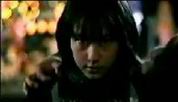
Sandwiched between his groundbreaking Gamera trilogy (1995-1999) and the ambitious Godzilla, Mothra, King Ghidorah: All Monsters Attack (2001), Shusuke Kaneko delivered this pacey psychic thriller. While the premise recalls stinkers like Firestarter (1984) and Spontaneous Combustion (1990), the movie actually upholds a proud J-cinema tradition of virginal heroines with devastating supernatural powers. Grainy 8mm flashbacks detail how when lonely little Junko is attacked by a teenage thug, she incinerates him with her pyrokinetic powers. “You’re not an ordinary girl”, warns her mother. “Don’t go near your friends.”
Years later, Junko (Akiko Yada) grows into a gloomy, young woman shunned by her fellow office workers, until hunky Tada Kazuki (Hideaki Ito) asks her out on a date. When a gang of sex attackers terrorizing Tokyo murder Tada’s younger sister, Junko offers to use her abilities to take revenge on arrogant Masake Kogure (S[Hidenori Tokuyama), son of a big-shot district attorney and immune from prosecution. But although she ambushes Masaki and fries half his face, Tada cannot bring himself to let Junko kill. However, her activities draw out Kouichi Kido (Yû Yoshizawa), a friendly fellow “Esper” who can read and control minds by touch (“If I touched Julia Roberts she’d play striptease!”). His encouragement spurs Junko into a firefight with the gang that leaves three bad guys frazzled, Masaki on the run and their latest victim mysteriously shot in the head.
Investigating detectives Ishizu (Kaori Momoi) and Makihara (Ryuiji Harada), the latter bearing a mysterious grudge against Junko, struggle to convince their colleagues there’s a psychic vigilante at large. Elsewhere, Kaori Kurata (Masami Nagasawa), a prodigiously gifted autistic esper, seeks out Junko as a surrogate mother.
Known internationally as Crossfire, and based on a novel of the same name by Miyuki Miyabe, this moves very well despite an overloaded plot. The special effects range from the spectacular - as Junko flings fireballs and stops bullets, Matrix-style - to the charmingly low-key, including a lovely sequence where two lovers kiss surrounded by a psychokinetic haze that gently melts the falling snow. For all the impressive exploding bodies, fiery deaths and melting faces, hardcore horror fans may not find this all that scary. This feels like Kaneko’s contribution to the J-horror movies aimed at adolescent girls, with stories that emphasise psychology, emotion and romance. Nothing wrong with that, and while the convoluted narrative is somewhat Hollywood in feel, its themes are very Japanese: grief, self-doubt, loneliness.
Most impressive is the way the pulp plot slowly evolves into a debate on the ethics of vigilantism. Kaneko doesn’t quite make this Carrie (1976) meets Ms. 45 (1980), but when his heroine discovers a vigilante group called the Guardians are behind the killings (“Killers and victims are vermin”, intones the nihilistic surprise villain), she realises her place in a vicious circle that threatens to consume everyone. Displaying Kaneko’s range as a genre filmmaker, the finale skips from tragedy amidst a fairground inferno, to an explosive comeuppance worthy of The Fury (1978), before ending on a solitary flickering candle that implies undying love and the birth of a new psychic lifeform.