A movie Jean-Luc Godard once urged audiences to see, claiming it delivered “the world in an hour and a half.” Opening credits scored by a serene Schubert sonata are disrupted by the newborn brays of a baby donkey. Little Balthazar grows up as a children’s pet, given a mock baptism by adoring youngsters Jacques and Marie. As they play together, the children fall in love, an innocent joy not destined to last after Jacques leaves this country idyll and returns home.
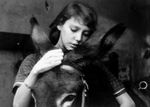
Summer is over. Childhood is over in a swift fadeout that sees a suddenly grownup Balthazar being cruelly whipped while he pulls a cart full of hay. His haste leads the cart to topple over, after which he is chased by an angry mob. Returning by chance to his childhood home, Balthazar is reunited with the now-teenaged Marie (Anne Wiazemsky), yearning to escape her oppressive father (Philippe Asselin). Marie and Balthazar are true soul mates, a union symbolized when she kisses his lips and garlands him with flowers. Both are let down by weak parents and victimised to the point of sainthood.
Juvenile delinquent Gerard (Francois Lafarge) takes a fancy to Marie, claiming her almost as his personal property, free to use or dispense with as he pleases. He and his biker gang vent their small town frustration by kicking and beating poor Balthazar on his daily errands. Yet, just as he sings like an angel in church, Gerard has a devilish charm that draws Marie to him like a moth to a flame, and compels his mother (Marie-Claire Fremont) into concealing his smuggling activities alongside drunken hermit, Arnold (Jean-Claude Guilbert). Eventually, Jacques (Walter Greens) returns to Marie’s life, now a duller, more facile young man, unable to respond to her needs. Thus Marie settles for the increasingly abusive Gerard, an impulsive desire that sends her and Balthazar spiralling towards their tragic, yet transcendental fate.
Robert Bresson’s austere directorial style takes some getting used to, with its concentration on people’s feet (If eyes are windows to the soul, do feet suggest our frailty and ties to the earth?) and characters who remain passive no matter how harsh their treatment. Yet his films are worth persevering with and quite unlike any others. He remains the most immediate of the great filmmakers - you don’t watch his movies, you live them.
Although he keeps them to the peripheries, Bresson can deal suspense (Gerard cruelly lends Arnold an unloaded gun to fend of the slowly-encroaching police), horror (the discovery of a gang-raped Marie, naked and shivering in an abandoned shack) and wonder. There is a magical sequence, involving Balthazar’s wryly amusing career as a circus performer, where caged tigers, monkeys, elephants and more come alive as character in the presence of genuine sainthood.
For Bresson martyrdom was a source of spiritual release. Even if you reject such a staunchly Catholic viewpoint, with the long-suffering donkey a mirror for the life of Jesus Christ, the film can still be admired for its philosophical ruminations on poverty, injustice and the nature of human existence. All related from a variety of viewpoints, be they Marxist, religious or capitalist. A lecherous merchant (Pierre Klossowski) counters Marie’s spiritualism with his own materialistic views (“I believe in what I own. I love money and hate death”). For her part, the saintly Marie fatally misunderstand what love is and goes looking for a saviour in the wrong place. It remains a deeply spiritual movie, even shorn of its Christian implications and applied to the secular world. And the moment Balthazar peacefully expires amidst a flock of sheep remains one of the most profoundly moving sights in world cinema.




 9 (from 3 votes)