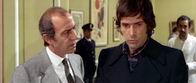
Alfred Hitchcock’s classic Strangers on a Train (1951) seems the likely inspiration for this offbeat giallo. Advertising hotshot Stefano Argenti (Tomas Milian) finds his playboy lifestyle threatened when his wife Luisa (Marisa Bartoli) refuses to sell her stake in the business. Shortly thereafter, he keeps running into foppish Count Mateo Tiepolo (Pierre Clementi), whose decadent ways include selling his girlfriend into sex slavery, “for the experience”, yet maintains he values friendship above love (“a distraction”). Worming his way into Stefano’s life, Mateo volunteers to murder Luisa if he in turn will bump off his supposedly abusive brother. It’s an offer Stefano doesn’t take seriously, until his wife turns up dead.
Mostly ignored since its release in the early seventies, The Designated Victim (also known as Murder By Design) has resurfaced thanks to Shameless DVD, who should be applauded for their restoration job from source materials of varying quality. With hazy visuals that, like Don’t Look Now (1973), evoke the fetid romance of the crumbling, Venetian locations and a delicately eerie theme song, “Shadows in the Dark” crooned by Milian himself, this is a suitably chilly affair, well-acted and elegant.
Like its Hitchcock predecessor, there is a homoerotic tinge to the way Count Mateo ingratiates himself with Stefano, stressing their duality (“We can’t live without each other. We’re like one person”) and displaying a childish need to keep him away from various women. At one point, he arrives looking like a battered housewife, meekly baring his wounds to convince Stefano his brother deserves to die. While many gialli revolve around vivacious, engaging heroines, The Designated Victim goes along with Mateo’s view and sidelines them as alternately vapid or neurotic, with Milian and Clementi as strong leads rising above the rather glacial supporting players.
Though Mateo hires a comely German hitchhiker to spend the night with Stefano and provide an alibi, he turns more menacing when his friend won’t cooperate. Yet what he wants isn’t quite that clear-cut, as the script takes an intriguingly sadomasochistic turn. Co-written by Maurizio Lucidi alongside several veteran giallo writers, the script features input from Aldo Lado. While perhaps best known for his Last House on the Left (1972) takeoff, Night Train Murders (1975), Lado’s own gialli, The Short Night of Glass Dolls (1971) and Who Saw Her Die? (1972), boast similar intent to experiment with the form and lend the psychological aspects a more palpable sting.
Leisurely paced and low on the tawdry thrills one expects from a giallo, this confines its exploitation elements to the peripheries, including a nude photo-shoot involving Stefano’s voluptuous, red-haired girlfriend Fabienne (Katia Christine). It’s a well constructed murder mystery that only suffers from substituting morose self-analysis in place of Hitchcock’s mordant wit. The revelatory ending is somewhat chaotic and hard to fathom, providing more questions than answers. But this is also the film’s best asset and its eerie atmosphere exerts a genuine hold.