Valentine Bluffs is a town with a secret, a tale the young people half-know, although the details are sketchy. It is a mining town, and T.J. (Paul Kelman) has returned there to work after a disastrous attempt to settle in the West Coast only to find his old girlfriend Sarah (Lori Hallier) has found a new love, Axel (Neil Affleck). T.J. and Axel are now co-workers at the mine owned by T.J.'s father, who has put him back to work, and he is simmering with resentment at his failures. But is he so angry that he will turn violent? For someone dressed as a miner is upset that the town's secret has been swept under the carpet: someone dangerous enough to kill to bring it back on the agenda...
Among the host of slasher movies that appeared in the late seventies and early eighties, My Bloody Valentine stood out as a cut above, if you'll pardon the pun. A Canadian entry into the genre, this had some innovations to bring to the already tired and apparently lazily conceived series of films that had come before, and as director George Mihalka's previous effort had been a broad teen comedy, you might have expected little from this, but that would be to sell it short. It was no Halloween, whatever its aspirations in setting its story at a famous day of the year may have been, but it did master an oppressive bleakness that many of its peers failed at.
The villain is, as folklore has it, an escaped mental patient who was trapped in a cave-in twenty years ago and survived six weeks by cannibalising the bodies of his dead workmates, thus sending him over the edge. He murdered the two officials he felt were responsible for the accident before being locked away, but could he be back? It's interesting that there's no question that what caused this tragedy was an accident, adding an unfairness to the murders that subsequently occur - it was nobody's fault really, it's simply a terrible pity that things have worked out the way they have.
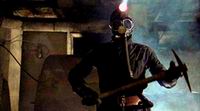
There's a wintry pall to Valentine Bluffs that adds to the grimness of the film, a grimness that not even the customary joking around by the young people can lift. It's as if they're whistling in the dark, only there really is a menace out there meaning to do them harm; the killer is one of the most sinister-looking of the era, dressed all in black and his features concealed by a gasmask and goggles, the light provided by the lamp on his helmet and the damage provided by his pickaxe. He sets about picking off the townsfolk, at random it seems, but triggered by the planned Valentine's Day celebration in the local hall.
It's less a puritanical urge that propels the murders and more a frustration at a dead end world and a wounded romance, literally in fact, where the thought of love emerging in this cold, hard mining environment is enough to bring out the worst in whoever the murderer is. The most obvious candidate is not the escaped madman, that would be too easy, no, it's T.J. who broods and lashes out as he awkwardly tries to rekindle his affair with Sarah - but is he too obvious as well? John Beaird's script keeps you guessing, and by the time it has settled in the mine for an unlikely party for the miners and their girlfriends, you forget how absurd it really is and concentrate on how tense the claustrophobic space has become. Acting may be serviceable, the plot may take some believing, but My Bloody Valentine has a forbidding quality all its own - definitely one of the best slashers of the eighties. Music by Paul Zaza, which doesn't feature anything by the alternative noise-rockers who took their name from the movie's great title, incidentally.




 Display comments