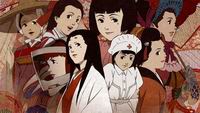
Manga artist turned animator Satoshi Kon is the most exciting talent active in anime today. Rather than pander to juvenile fantasies or industry trends, his movies draw from a more personal muse. Enriching the medium’s warmth and vitality with mature storylines and complex characters, they are ideal for world cinema enthusiasts who might otherwise give anime a miss. After making a splash with the groundbreaking anime giallo Perfect Blue (1997), Kon delivered a masterpiece that, despite being distributed by DreamWorks in the USA, may have passed you by.
In modern Japan, after seventy years of movie-making, the venerable Ginei Film Studios are demolished. Devoted fan and documentary filmmaker Genya Tachibana (Shozo Izuka) and his jaded, twenty-something cameraman Kyoji Ida (Masaya Onosaka) track down the studio’s biggest star, reclusive actress Chiyoko Fujiwara (Miyoko Shoji). Returning to her a mysterious key, the star-struck Tachibana coaxes Chiyoko into recounting her life story.
As a teenager in the 1930s, living under the military rule, Chiyoko (Fumiko Orikasa) rebelliously shelters a young painter/human rights activist (Kouichi Yamadera) from a scar-faced government agent (Masane Tsukayama). Her good looks draw offers of movie stardom, which her overbearing mother (Naoko Kyoda) sharply declines, preferring she should find a husband and stay at home. But when the artist flees to China, Chiyoko agrees to headline an epic set in Manchuria so they can be reunited, thus beginning a lifelong search for her elusive, true love.
Fact blurs with fiction as Chiyoko’s life is filtered through the fictional roles she played, with Tachibana and Ida magically reliving her life and cinematic adventures in real time. Tachibana becomes an active participant, repeatedly taking the role of Chiyoko’s protector in various guises. After her train is attacked by Manchurian bandits, Chiyoko time-leaps into a supernatural samurai epic reminiscent of Akira Kurosawa’s Throne of Blood (1957), where she meets a ghostly witch who plagues the rest of her life. We leap into ninja girl movie, whose high-flying fantastical fights evoke Shinobi no Mono (1960) and Watari Ninja Boy] (1966), with Tachibana hilariously stoic as a Clint Eastwood-style swordsman.
Next comes a geisha drama that finds Chiyoko again at the mercy of resentful, older actress Eiko (Shoko Tsuda). A Victorian romance, a Second World War survival drama where bombs fall on Japan (“Is this a science fiction movie?” asks young Ida), a schoolteacher melodrama and a great big monster movie, complete with fire-breathing Godzilla imitator, flicker before our eyes. The time jumping and constant shifts between reality and fantasy can get confusing, but the complex story is richly detailed and rewards repeat viewings. It sweeps gloriously from the epic to the intimate. From an awe-inspiring space station orbiting planet Earth, to Chiyoko’s poignant discovery of her portrait painted on a bombed out ruin in Tokyo.
Satoshi Kon admits he drew inspiration from actresses Setsuko Hara, the star of Tokyo Story (1953) who suddenly withdrew from public life after a thirty year career, and Hideko Takamine, who started out as the Japanese Shirley Temple before headlining masterpieces like Twenty-Four Eyes (1954). Yet he is equally adamant, Chiyoko is a “universal character”, someone who embodies our relationship with cinema as a outlet for creative, escapism and anxiety.
While the animation dazzles in its fluid amalgamation of Japanese Ukiyo-e woodblock prints, abstract visuals, still photos and painterly images, it’s the poignancy of the story that resonates. Almost every character carries a secret and like Hayao Miyazaki, Kon refuses to box characters into good or evil. In a notion that reoccurs in Kon’s equally dazzling Paprika (2007), reality and fantasy are not separate, but co-exist, alternately disrupting and nurturing each other. Stirring and profound, with a soaring soundtrack, the film concludes it isn’t the dream but chasing the dream that we really love.
Japanese director of intelligent, innovative anime. A former comic book artist, Kon worked as a background artist on a variety of anime projects before directing hs first feature, the psychological thriller Perfect Blue. His subsequent work met with equal acclaim - Millennium Actress, Tokyo Godfathers, the complex TV series Paranoia Agent and Paprika. Sadly, he died while working on his final film, The Dreaming Machine.