Sukeban Deka - roughly translated as “delinquent schoolgirl detective” - has been a Japanese pop cultural phenomenon since the mid-seventies. The crime-fighting schoolgirls and their trademark high-tech yo-yos were created by Shinji Wada in his 1976 manga, which was followed by an immensely popular television series in 1978. Much beloved original “deka girl”, Yuki Saito - the Sean Connery of Sukeban Deka, if you will - left the show in 1982 to become one of Japan’s biggest pop stars.
Accomplished actress Yoko Minamino took over as a new heroine during the show’s next five years and for Sukeban Deka: The Movie (1987), until succeeded by feisty Yui Asaka in Sukeban Deka 2: Zazoom (1988) and Sukeban Deka 3 - Assignment: Eight Trapped Spirits (1992), which ended on a cliffhanger that was never resolved. In the interim there was a lacklustre anime adaptation plus a host of spoofs, imitators and porno parodies, but Toei Studios’ Yo-Yo Girl Cop marks a significant comeback.
In the arresting opening scene, a handcuffed deka girl staggers through a Tokyo shopping district with a ticking bomb strapped to her chest, until she explodes before horrified onlookers. Meanwhile in New York, violent runaway schoolgirl Saki Asamiya (Aya Matsuura) is arrested by the F.B.I. after she hospitalises eleven officers of the NYPD. Trussed up in a straightjacket and metal mask like Hannibal Lector, Saki is entrusted to crippled ex-cop Kazutoshi Kira (Riki Takeuchi), who once worked with her mother and now offers Saki the same deal. Join the sukeban deka squad or rot in jail.
Outfitted with her trick yo-yo and cute schoolgirl ensemble, Saki is assigned to investigate Enola Gay, a terrorist organisation (named after the plane that dropped the Hiroshima bomb) whose website features a clock counting down to doomsday. Their activities are traced to a local high school where Saki discovers rampant bullying, while the teachers remain callous and indifferent. After wiping the floor with teen thugs, she clashes with über-bitch Reika Akiyama (Rika Ishikawa), but finds a friend in lonely, abused Taie (Yui Okada), who points the way to an internet chat-room for bullied kids, a group of science geeks getting a little too creative with chemicals, and a charismatic teen genius (Shunsuke Kubozuka) with a messiah complex.
As an action movie this is somewhat hit and miss, with most of the outlandish set-pieces restricted to the last thirty minutes. Fans will nonetheless relish Saki’s crowd-pleasing yo-yo duel with the latex hotpants clad Reika. Kenta Fukasaku, son of cult filmmaker Kinji Fukasaku, takes a somewhat oblique approach to his storytelling, yet the script proves surprisingly deep and touches on pertinent issues like teen suicide, self-harm and high school shootings. Time and again, the filmmakers highlight adults inability to relate to/deal with the problems of teenagers, be they Saki’s emotionally withdrawn mother (a cameo from Yuki Saito) or the callous principal who bluntly states: “There is no bullying in this school”, then slaps a girl for asking embarrassing questions.
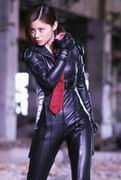
The grownup’s disturbing attitude seems to be that the strong will purge society of its weak, so everybody turns a blind eye while the victims struggle to fend for themselves. Fukasaku stirs in elements from 24, Nikita (1990), and Arlington Road (1998), as the traumatized heroine bonds with the grizzled ex-cop and a website created as a haven for victims of bullying is co-opted by a young criminal genius. Saki emerges as a psychologically complex anti-heroine, prone to fits of rage, but driven to protect abused children. Although knocked unconscious rather too often (once by her own backfiring yo-yo!), Aya Matsuura makes a fine addition to the roster of deka girls and looks especially gorgeous in the slinky, leather body armour she dons for the all-action finale. Love that red tie.
Son of the late, great Japanese director Kinji Fukasaku who scripted his father’s satire Battle Royale and took over directing the sequel, Battle Royale 2: Requiem when Kinji died in 2003.