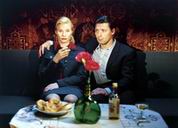
Koistinen (Janne Hyytiäinen) is a security guard at a Finnish shopping centre. He hates his job, but not as much as his co-workers hate him, not for any real reason, he has simply been singled out as a loser, which, sadly, is what he is. He does not wish to stay in this situation forever and has dreams of setting up his own business, and is taking classes to that end, but by night he is has to endure the unfriendly atmosphere of his workplace. However, one day he is sitting alone taking a beverage when a woman, Mirja (Maria Järvenhelmi) approaches him - could things finally be looking up?
Well, no not at all, and even for writer and director Aki Kaurismäki Lights in the Dusk, or Laitakaupungin valot if you were Finnish, was downbeat stuff. But this is precisely what his admirers want from one of his films now, and the manner in which he grinds down his lead character is curiously cathartic - not because you relish seeing an innocent and lonely man being beaten down by life, but because just when you think Kaurismäki is going too far in his treatment of him, he produces a final shot that is really rather moving.
There's a lot of misery to get through before you reach that, of course, and the plot is your basic film noir affair, with Koistinen seduced by a femme fatale who is not out to make his existence better, but to exploit him on behalf of her boss. Not that he is aware of this, being wincingly glad of the company even if the emotions are kept resolutely beneath the surface. Mirja does not even sleep with him, simply allows him to take her out to gain his confidence and then persuade him to take her on a tour of the shopping centre.
This she does so she can work out the security procedures and report back to the gang planning a robbery of the jewellers therre. In a style typical of this genre, there is a good woman in all this, the one person who respects our hero and could offer him comfort if he would allow her to give it to him, and she is Aila (Maria Heiskanen) who works in a fast food van nearby. Yet it is as if Koistinen cannot accept any love, and pretty much willingly goes to his doom at the hands of the criminals and the pathetic semblance of affection that the glamorous Mirja offers him.
False attention is what Koistinen evidently believes is all he deserves, and if there is humour here, Kaurismäki practically buries it under a heap of depression. Therefore what passes for a gag is when the protagonist goes to secure his loan from the bank, only to be asked if he is a comedian by the manager and turned down flat. If that sounds funny to you, the amusement that stems from utter despair, then you may derive a few laughs from Lights in the Dusk, but mainly it's the dejection that is concentrated on as Koistinen finds himself going to prison for a crime he had no part of, and the unfairness of his situation is deeply felt. Yet so is that final scene, where he might have actually learned his lesson and allowed love into his life: it's a touching and sweet ending to a film that has, up to that point, been little of the sort.