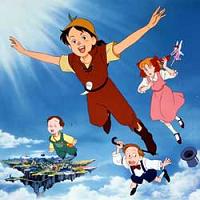
J.M. Barrie’s classic novel is given an anime twist in this sprightly, inventive feature film assembled from episodes of the Japanese television series. It opens, excitingly, with Wendy (Naoko Matsui), John (Kyoko Hamura) and Michael (Yuriko Fuchikazi) fleeing pirates aboard a flying galleon. Forced to walk the plank, Wendy teeters above a terrifying, giant cloud monster until Peter Pan (Noriko Hidaka) flies to her rescue. Whereupon the Darling children wake up and discover they shared the same dream.
Children’s anime veteran Yoshio Kuroda, whose past work includes classics like Gulliver’s Space Travels: Beyond the Moon (1965) and The Dog of Flanders (1975), builds the magic and mystery presaging Peter’s first visit, exceptionally well. We glimpse a shadowy figure skipping over the rooftops of Edwardian London, while tiny bursts of golden fairy dust herald the arrival of sexy, pink-haired Tinkerbell. When Tink enters the children’s bedroom, toys begin to dance recalling that famous scene in Close Encounters of the Third Kind (1977).
In the first of several new elements that prefigure P.J. Hogan’s revisionist Peter Pan (2003), it is Wendy who does not want to grow up. She and her brothers fly away with Peter to a Never Land that, rather than keeping them in stunted infancy, helps the kids mature. Little Michael stops wetting the bed, John loses his anxieties, and Wendy blossoms into a capable, confident young woman. Far from a simpering damsel, she becomes a gutsy heroine with a knack for disarming psychological insights into Peter, the Lost Boys and even arch-nemesis Captain Hook.
The plot sticks fairly closely to Barrie’s original for the first half hour, but with anime eccentricities like the giant cannon and clockwork animal super-weaponry the Lost Boys use when defending their tree house, the charming J-pop score and the moment Tootles (Kazue Ikura) straps balloons and wheels onto a sailboat to make a nifty all-terrain vehicle. The flying sequences and edge of your seat action are beautifully animated and manage more of an Indiana Jones feel than Steven Spielberg managed with Hook (1991). Here, Peter Pan is as strong as Superman, able to catch boulders or fling heat-seeking missiles (!) back at his enemies.
Never Land becomes a giant island floating in the sky, which children explore in rich detail, flying up its roots, over the rainbow and into a vast, sumptuous fairyland. While other cinematic incarnations are curiously under-populated, this Never Land teams with exotic birds, strange flowers and magical animals, including reoccurring character Rascal the racoon. We race through the rescue of Princess Tiger Lily (who like Wendy, rallies the boys whenever things look bad, and as in Hogan’s film becomes John’s love interest), Wendy’s encounter with the lovely mermaids who are dangerously ga-ga over Peter (a scene that strikes a better balance between enchanting, erotic and scary than previous versions), and Tinkerbell’s betrayal and redemption. She doesn’t drink poison, but risks her life to defuse a lethal death-trap, while the “I do believe in fairies” sequence is reworked into an apocalypse-averting climax worthy of Akira (1988). No surprise, since character designer/animation director Takashi Nakamura worked on that same movie.
After the thrilling final battle with the pirates in a subterranean lost city, which sees Wendy dangled from the arm of a giant robot over a vast chasm, Peter finally takes care of Hook (who, in an intriguing quirk, is haunted by the death of his mother, whom he may have killed). Hereafter, things get delightfully trippy and weird. Never Land suddenly starts to wither and die and the heroes encounter the outlandish Rain Giant and Memory Bird, who lives in a rainforest atop the giant’s head and prophesises doom.
To restore Tinkerbell’s soul, Peter, Wendy and the Lost Boys journey to the Castle of Darkness where mystical stones, space-age hovercraft and speeder bikes that deliberately evoke Return of the Jedi (1983) and a mysterious young princess on the run from the sinister Black Cloak Group, turn this into an Edwardian science fiction-occult-conspiracy thriller for kids. Needless to say, this strays from J.M. Barrie’s original story, but stays true to his themes and wraps things up on a suitably poignant note.