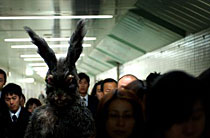
Trapped in a seemingly loveless marriage, bored salaryman Yuichi Arisu (Koichi Sato) escapes his daily grind by reading supernatural mystery novels by best-selling author, Jo Kuroda (Kazuyoshi Kushida). Arisu has a surreal encounter with Mr. Trickster (Akira Emoto), an old grouch in a rabbit costume distributing flyers for Kuroda’s latest novel: ‘Starfish Hotel’, and is haunted by vivid dreams of the book and memories. He recalls his torrid affair with Kayoko (Kiki), a sultry young woman whom he met at a hotel of the same name. When his wife Chisato (Tae Kimura) mysteriously disappears, Arisu contacts a private eye whom he discovers she once hired to spy on him. Though the detective knows more than he is letting on, Arisu’s search proves fruitless until Mr. Trickster provides a clue that implies Chisato is held captive at an exclusive, high class brothel called Wonderland.
Hertfordshire-born writer-director John Williams is in the interesting position of being a Brit making Japanese films. For his sophomore outing, following the engaging Firefly Dreams (2001), Williams wears his influences on his sleeves. The surreal meta-fiction of J-novelist Haruki Murakami (who himself produces weak-kneed knockoffs of manga narratives English critics can’t be bothered to read) is an obvious source, but elements like the sinister rabbit-man, a secret club who hold clandestine orgies, the unfaithful spouse who prompts a midnight odyssey, an erotically twisted femme fatale and eerie soundscapes of distorted voices allude to Donnie Darko (2001), Eyes Wide Shut (1999) and the collective works of David Lynch. The central notion of an innocent trapped in the fictional world of a sinister writer also recalls John Carpenter’s In the Mouth of Madness (1995).
The end result of threading these disparate threads together with allusions to Alice in Wonderland (surreal chatter, talking rabbits, holes that lead to strange dream worlds) is a meandering maze that proves tedious and - for all the strangeness going on - surprisingly devoid of humour. Its self-conscious surrealism disguises the fact this treads a well worn path, with a trite statement about the darkness of the human soul no different from those uttered before. Performances are strong across the board and do much to hold our attention throughout the disordered narrative. While the plot takes promisingly creepy twists and turns, with corpses piling up and fleeting shock imagery, much of the tension is squandered and the constant flashbacks and forwards prove confusing.
Williams and cinematographer Benito Strangio make inventive use of the expressive colour palette and production design, with only the lacklustre Wonderland brothel failing to conjure a heady atmosphere of threat or eroticism. The sex scenes - sparse and non-explicit - have a clinical, antiseptic quality that befits a tale of urban alienation, but fail to convince us of Arisu and Kayoko’s reckless passion. Although the story displays sympathy for human failings, the capriciousness of the main characters strains patience and ultimately distances us further from this waking dream.