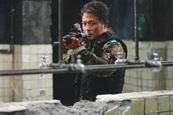
A squad of South Korean soldiers storm a bunker positioned on the North-South Korean border and discover axe-wielding maniac, Corporal Kang (Lee Young-Hoon) standing over a bloody pile of corpses. The military authorities despatch Sgt. Major Noh (Jeon Ho-Jin) to investigate. He recovers a half-erased videotape wherein the formally mild-mannered Kang confesses his intention to slaughter the other soldiers and later, stumbles onto the sole survivor: 1st Lieutenant Jeong-u Yoo (Cho Hyun-Jae). Initially reluctant to provide answers (“A soldier talks in a soldier’s way. Like a soldier”), Yoo’s recollections gradually piece together the story of an isolated platoon driven mad by mysterious terrors. But all is not as it seems, and as Noh’s men slowly succumb to violent delusions, he realises their fates are sealed.
If there is one word to describe this Korean shocker it would be: confusing. Structured as a series of flashbacks and flash forwards, the build-up is quite bewildering as it’s hard to work out which particular soldier is in the past or present day platoon. The roster of alternately panicky or tediously stoic characters eventually blend into a mishmash and we’re left scratching our heads despite some daring plot twists and the impressively grim tone. Initially the film recalls those World War One horror films from several years ago (The Bunker (2001), Deathwatch (2002)) and director Kong Su-chang - who made the similarly themed R-Point (2004) - borrows a few tricks from John Carpenter’s The Thing (1982) (Alsatian dogs are the first to fall prey to a prowling evil, in a confusing sequence never really explained).
The plot pulls a role reversal halfway through that would seem a lot cleverer were the story any easier to follow. What seemed like a massacre might in fact have been a mercy killing. Identities are switched, heroes become threats and the film takes off in a vaguely science fiction horror direction. Even after we are given an explanation, things aren’t entirely clear and the actions of several characters remain hard to fathom. Too much contemporary Korean cinema draws from the Jerry Bruckheimer school of hyperbole, whose mark is felt here in broody, but paper thin lead characters Sgt. Noh and Lt. Yoo and an array of nondescript grunts whose profane dialogue (“F*** you, you f***ing mother****ers!”) borders on parody. Lee Jeong-Heon is interesting as a jaded doctor, more interested in his I-pod than solving the medical mystery, but his indifference goes unexplained.
Full of characters wandering alone down dark corridors (“Is that you? Stop messing around!”), freaky hallucinations and extreme gore (faces wracked with pulsating boils or half-ripped open), plus a music score that is distractingly similar to Nino Rota’s theme from The Godfather (1972). Beneath the fractured timelines and perspective switcheroo, this tells a fairly conventional “virus makes people go crazy” story and is quite overlong.