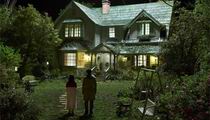
While arguing on the phone with his pregnant girlfriend, Eun Soo (Jeong-myeong Cheon) crashes his car. He awakens deep inside a dark forest where twelve year old, red cloaked Yeong Hee (Sim Eun-kyung) leads him to “the House of Happy Children”, a picture perfect fairytale house full of toys, sweets and twee pictures of bunny-rabbits in fancy dress. Here, Eun Soo meets her eerily cheerful parents and playfully sinister siblings: big brother Man Bok (Eun Won-jae) and kid sister Jung Soon (Ji-hee Jin), who take a shine to the stranger. Stranded without his cel phone, Eun Soo recuperates for the night but notices scary noises coming from the attic, a ghostly apparition creeping in the dark, and overhears the parents plotting their escape. He tries to leave the next day, but is unable to escape the forest. The day after that, mom and dad have disappeared, leaving a note asking Eun Soo to look after the kids, who serve him some suspicious meat for breakfast.
For his sophomore outing, Korean filmmaker Pil-Sung Yim has created a creepy fairytale with a narrative that proves pleasingly complex and disorientating. He aims for skin-crawling eeriness rather than gut-wrenching terror, but the ambiguously unfolding plot keeps us on the edge of our seat and throws in a good few scares. Weaving elements from The Shining (1980) and Night of the Hunter (1955), and teasing out the more sinister undercurrents from C.S. Lewis (a magical blue door in the woods that leads to a secret world), Hans Christian Anderson (Jung Soon brings tin toys to life) and the Brothers Grimm (a veritable cornucopia of fairytale imagery), the premise also recalls Jerome Bixby’s famous Twilight Zone episode: “It’s a Good Life”, later remade by Joe Dante in Twilight Zone: The Movie (1983). Yet what delights most is how nothing happens the way we expect it to.
Trapped in a storybook fantasy, Eun Soo is initially aghast when the children bring home another stranded couple, but hymn-humming preacher Deacon Byun (Hee-soon Park) and his icily callous wife prove even more psychotically dangerous. The new arrivals flip everything on its head, as she repeatedly slaps Jung Soon and he makes lewd advances towards the beautiful Yeong Hee. Eun Soo slowly becomes protective of the monster children, battles with Deacon for their attention and discovers some unpalatable truths about the people they bring home to play mommy and daddy.
The script plays on Eun Soo’s anxieties over impending fatherhood (in a beautifully played scene he enchants the girls with a fairytale drawn from his own tragic past) and draws parallels with the children’s refusal to grow up, because they know what adults do. Yim and co-screenwriter Min-sook Kim keep the children teetering between scary and sympathetic. While the source of their superpowers remains a rather vague, semi-imaginary encounter with Santa Claus (another nod to C.S. Lewis), the flashbacks to the house’s unhappy past of child abuse and exploitation serve the psychological aspects very well. One gut-wrenching scene, simultaneously affecting and horrible, sees Yeong Hee volunteer for sexual abuse to save her little sister.
A visually arresting film, the whimsical production design and imaginative cinematography evoke a world of Disneyesque fantasy gone horribly wrong. Yet for all its grotesquery and horror, woven through is a redemptive message of innocence and hope that makes this a surprisingly emotional experience. In its own twisted way, Hansel and Gretel would be a fine ghost story to watch over Christmas. The shivery lullaby sung over the end credits is rather lovely too.




 Display comments