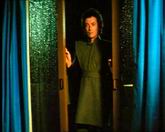
What is worrying Senator Nick Rast (David Hemmings) are two things: the health of his son, and the disappearance while diving in the sea of one of his political allies. His son Alex (Mark Spain) is suffering from leukemia and by the doctor's estimate does not have long to live, but they go ahead with his latest birthday party anyway, in spite of the boy's gloomy and exhausted demeanour. At the party there is a silent clown (Robert Powell) who is very adept at magic tricks, and he manages to cheer up Alex briefly, but this clown has a name, Gregory Wolfe, and a mission to insinuate himself into the Rasts' lives...
The actors in Harlequin all have either British or American accents, but there's a curious atmosphere about this supernatural tale that marks it out as Australian. For some reason the filmmakers decided to play down the connection to their native land, so we're not sure exactly where the characters are supposed to be from, but the essential Aussie-ness cannot help but show through in that style peculiar to this country's cinema. Maybe it's something to do with the connection to nature that is apparent in many of the genre works from there, as the Wolfe character seems to have tapped into the power of the environment.
None of this you would find in the film's inspiration, that is the historical facts of Rasputin and his influence over the Russian royal family, with Powell playing the so-called "Mad Monk" role (Rast is Tsar backwards, you'll note). Here the Harlequin of the title is a far more playful character, with Powell channelling the enigmatic personality of his Jesus of Nazareth part, but no less sinister for all that, as we don't know his exact motivations. In fact, even at the end his purpose is not entirely clear, and it's this vagueness which undercuts what might have been an intriguing plot.
That plot was scripted by Everett De Roche, an interesting character in Australian horror, fantasy and science fiction movies, having penned many cult favourites such as Patrick, Long Weekend and Razorback to name a few. He had a handle on a genuine strangeness with this kind of thing, which although not always successful, made for memorable stories if nothing else, as is the case here. The problem is that once he has introduced his Rasputin to the political scene, he finds himself with nowhere to go, and the film winds up in an underwhelming and predictable fashion.
Still, there are interesting aspects here, not least for its view of the political scene as something more insidious and dangerous than a mere magical mystery man. Rast's fixer is Doc Wheelan (Broderick Crawford), who pulls strings for his protege while apparently having an agenda of his own: we never discover whether he had anything to do with the disappearance at the beginning, but we have our suspicions. It is Doc who grows resistant to Wolfe's presence, as if there were room for only one manipulator in Rast's life, and with Wolfe making Rast's wife Sandra (Carmen Duncan) fall in love with him (her marriage was one of convenience, with no affection) and little Alex under his spell, Doc puts plans into motion which will see Wolfe's downfall. We're not sure whether the Harlequin is an expert conjuror or a truly otherworldly character, which offers some much needed tension in a film which needed a better sense of purpose. Music by Brian May.
Australian director who began working in TV in his homeland. Directed the horror flick Snapshot, before heading to Hollywood scoring a hit with the sci-fi adventure D.A.R.Y.L. Wincer had success on the small screen with the award-winning western Lonesome Dove and The Young Indiana Jones Chronicles, and on the big screen directed the likes of Free Willy, Quigley Down Under and The Phantom.