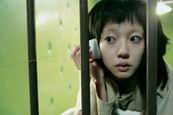
There's a new patient on this ward of the mental asylum, and she is, to all intents and purposes, catatonic after a breakdown at work. Her name is Young-goon (Lim Su-jeong), and she is anorexic although the doctors cannot work out why. As she lies on the bed, she attracts the attention of other patients and is told a rambling story by one woman who, it is explained by another, is a compulsive liar because of her memory loss. But Young-goon is not as catatonic as she might appear, it's just that her batteries are running low, for she isn't really human: she's actually a cyborg.
Yet despite what the title may say, this is definitely not OK. It is her psychosis making our heroine believe that if she takes food she will break that is at the heart of her dilemma, and as she won't tell the doctors the real reason for her anorexia she is gradually dying. If this sounds like it's setting the scene for a tearjerking tragedy, then you may be surprised with the manner in which director and co-writer Chan-wook Park handles his material; let's just say it's not exactly One Flew Over The Cuckoo's Nest. In fact, it's more like a cutesy anime brought to misguided life.
Most people didn't know quite what to make of this filmmaker's next film after his cult sensation Vengeance trilogy: was this the same man who brought us the downbeat and grim tales of revenge and the damage it causes? There's still a measure of violence in this, but it's strictly fantasy material as Young-goon imagines herself as some kind of battle droid, gunning down the hospital staff in a hail of machine gun fire from her fingers as the bullet casings spill from her mouth. Typical self-empowerment fantasy, really, and irresponsible with it, getting back at the authority figures she sees as inhibiting her.
The trouble is that Park approaches the not too hilarious problem of mental illness as something magical and liberating in the right hands, so Young-goon has a counterpart in Il-sun (Korean pop star Rain), a kleptomaniac who uses his condition as a method of emancipation. None of the patients we see have any connection with real world psychosis, they're like characters in a sitcom, and it's easy to grow uncomfortable with a film that presents them as goofy and endearing, as if their quirks were simply that: you cannot envisage anything really terrible happening to them as a result of their illnesses.
Ah, you ask, but what of Young-goon? Isn't she endangering her life by believing she is a machine? Well, yes, but the way she is saved by Il-sun is to indulge her in her madness as he falls in love with her, yet another example of how airy-fairy Park's feeble grasp on his subject is. So we get the poor girl talking to various appliances, regretting the loss of her equally afflicted grandmother who, in an eye-rolling twist, was about to reveal the meaning of life to her as she was whisked away in an ambulance, and justifying her damaged feelings through pictures in a child's book. It's visually arresting at times, but overall I'm a Cyborg is hopelessly precious and cloying, not to mention particularly unhelpful in its depiction of the field of mental health. Music by Jo Yeong-wook.
Controversial Korean director with a strong visual sense. Made his debut in 2000 with the powerful political thriller JSA, which dealt with the divide between North and South Korea. Follow-up Sympathy for Mr. Vengeance was a gruelling tale of revenge, and Park contributed to the human rights anthology If You Were Me. Oldboy was another acclaimed revenge movie, while Cut was Park's entry into the Asian horror anthology Three... Extremes. In 2005, Park completed his 'revenge trilogy' with Sympathy for Lady Vengeance. He received mixed reviews for I'm a Cyborg, But That's OK, with his modern day vampire story Thirst seen as a major return to form. His first English-language work was the reserved horror drama Stoker which he followed with arthouse hit The Handmaiden.